
Heavy Rain Floods Lagos Roads as Agencies Warn of Greater Flood Risk
Heavy rainfall flooded major Lagos roads, disrupted airport operations and businesses, while federal agencies warned that the state faces heightened flood risks between July and September amid above-normal rainfall forecasts.
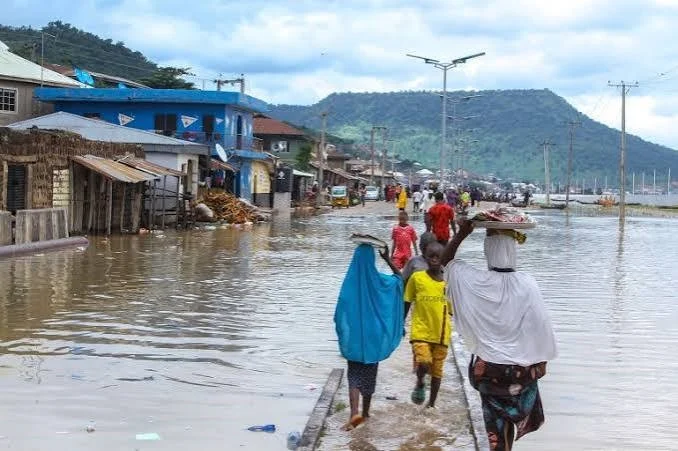
Heavy rainfall that submerged major roads, disrupted businesses and temporarily affected operations at the international terminal of the Murtala Muhammed International Airport has heightened concerns over flooding in Lagos, as federal agencies warn of greater flood risks in the coming months.
The downpour, which occurred on Sunday, inundated several parts of the state, including Oshodi, Mushin, Surulere, Fashoro Street, Akowonjo Road in Egbeda, Gbagada Expressway and Idi-Oro, leaving commuters stranded and residents counting losses.
At the Murtala Muhammed International Airport, floodwaters reached the terminal’s powerhouse, prompting the Federal Airports Authority of Nigeria to suspend operations at the temporary international terminal as a precautionary safety measure.
The disruption forced authorities to cut electricity supply while international airlines, including Air France-KLM, Ethiopian Airlines and Fly Gabon, were temporarily relocated to Terminal Two.
Floodwaters rose to knee level in parts of Gbagada, Ipaja and Surulere, disrupting movement and commercial activities. In Oshodi, passengers scrambled for safety as roads and sections of the transport terminal became submerged.
Videos circulating on social media also showed vehicles partially underwater, with floodwaters entering residential buildings in several communities and leaving the ground floors of some homes almost completely submerged.
Although floodwaters had largely receded by Monday morning and commercial activities gradually resumed, many residents said the incident highlighted Lagos’ continued vulnerability to flooding despite ongoing government interventions.
Meteorological and emergency management agencies have consistently identified Lagos as one of the states facing significant flood threats during the 2026 rainy season.
The Nigerian Meteorological Agency projected above-normal rainfall across the state, forecasting annual rainfall of up to 2,010 millimetres in Badagry and an average of 1,965 millimetres across the state’s local government areas.
Similarly, the Nigeria Hydrological Services Agency classified Lagos among states facing high flood risk, warning of flash floods, river flooding and coastal tidal surges driven by intense rainfall, urbanisation and drainage challenges.
The National Emergency Management Agency also listed Badagry, Epe, Alimosho, Ikeja and Surulere as areas vulnerable to flash flooding, while cautioning that Ikorodu and Isheri remain at risk from possible water releases from Oyan Dam.
The Lagos State Government said it is expanding both immediate and long-term drainage interventions to minimise flooding and protect lives and property as the peak rainy season approaches.
Related stories
 News
News
WhatsApp Replaces Phone Numbers with Usernames in New Privacy Update
WhatsApp has introduced username reservations, allowing users to connect without sharing phone numbers. The new privacy-focused feature also includes an optional username key for added protection against unwanted messages.
 News
News
Superior Firepower Only Solution to Ending Terrorism — Mahdi Shehu
Public affairs commentator Mahdi Shehu says terrorism can only be defeated through superior military force, rejecting amnesty for terrorists and insisting convicted criminals should face the full weight of the law.
 News
News
Security Personnel Foil Attempted Bandits’ Attack on NIPSS in Plateau
Security personnel repelled suspected bandits attempting to breach NIPSS in Plateau, forcing them to flee without casualties as authorities intensify security around strategic national institutions after recent threats.
 News
News
NSCDC Seeks Public Support to Protect FCT Infrastructure
The NSCDC has urged FCT residents to report vandalism and suspicious activities, warning that protecting critical infrastructure is a shared responsibility as enforcement against vandals and unlicensed security firms intensifies.
Comments (0)
Leave a comment
All comments are moderated before publishing. Your email is never published.