
Factional Feud Triggers Legal Standoff as Dual Legal Teams Claim Representation for PDP in Suit Against INEC
A federal court hearing stalled in confusion after two separate legal teams showed up, both claiming to be the authentic counsel representing the Peoples Democratic Party (PDP) in a lawsuit against INEC.

A high-stakes legal battle over the leadership structure of the Peoples Democratic Party (PDP) triggered dramatic scenes and procedural confusion inside a federal courtroom, after two separate legal teams simultaneously announced their appearance to represent the main opposition party. The legal conflict unfolded during the hearing of a suit filed by the Chairman of the PDP Board of Trustees (BoT), Senator Adolphus Wabara, and other key stakeholders against the Independent National Electoral Commission (INEC).
The litigation follows a recent landmark Supreme Court judgment that nullified the party’s National Convention in Ibadan, which had originally elected a National Working Committee (NWC). In the wake of that ruling, the Wabara-led BoT moved to assume administrative leadership of the party and institute interim management frameworks, an action that has been fiercely rejected by an opposing internal faction loyal to prominent state actors.
When the case was called before the presiding judge, a senior advocate announced his appearance as the duly authorized counsel representing the PDP, acting on instructions from the national leadership aligned with the BoT's post-judgment stabilizing measures.
However, before the court clerk could record the appearance, a second prominent legal team stepped forward, brandishing separate counter-instructions from an opposing faction within the party. The rival lawyers insisted that they held the legitimate mandate from the recognized national organs to manage all ongoing litigation involving the PDP and INEC.
The presence of dual legal representations sparked an immediate debate between the counsels, with each team questioning the constitutional authority of the other to act on behalf of the political institution. The opposing sides traded arguments regarding which executive organ possesses the legal backing to hire external legal representation under the current, highly fractured party constitution.
Faced with the structural deadlock and conflicting notices of appearance, the trial judge expressed deep dissatisfaction with the internal disorder being imported into the judicial process. The court noted that a single corporate or political entity cannot speak with two distinct voices within the same legal proceeding.
Consequently, the judge adjourned the matter to a later date, directing both legal teams to return to their respective party factions and resolve the representation conflict administratively, warning that the court would not serve as a battleground for internal party squabbles.
Related stories
 News
News
Military Offensive Neutralizes Bandit Enclaves in Katsina, Liberating Abductees Held in Forest Camp
A joint military operation involving the 17 Brigade Strike Group and special forces has successfully overran an enclave belonging to bandit kingpin Kachalla Muhammadu Fulani in Fafu Village, Katsina State.
 News
News
"We're Here for a Religious Crusade," Claim 25 Foreign Nationals Arrested by Lagos Police for Lacking Legal Residency
The Lagos State Police Command has arrested 25 undocumented immigrants during a targeted intelligence-led raid on an illegal residential hub in the state.
 News
News
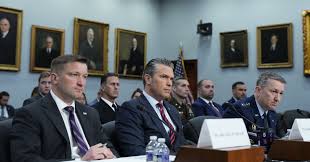
Pentagon Informs Legislators It Requires $80 Billion to Offset Middle East Military Operations, Domestic Priorities
The U.S. Pentagon has informed lawmakers that it requires an $80 billion supplemental funding package to cover the expenditures of the recent war with Iran and clear other domestic legislative bills.
 News
News
Nigeria Democratic Congress Officially Refutes Unauthorized Candidate List Circulating Online
The Nigeria Democratic Congress (NDC) has officially disowned a list of party candidates currently trending across social media platforms, labeling the document as a total fabrication.
Comments (0)
Leave a comment
All comments are moderated before publishing. Your email is never published.