
Local Fish Production Falls Short of Nigeria’s National Demand
Nigeria’s fish industry still cannot meet domestic demand, with local production lagging far behind consumption and forcing the country to rely heavily on imports despite recent gains in output
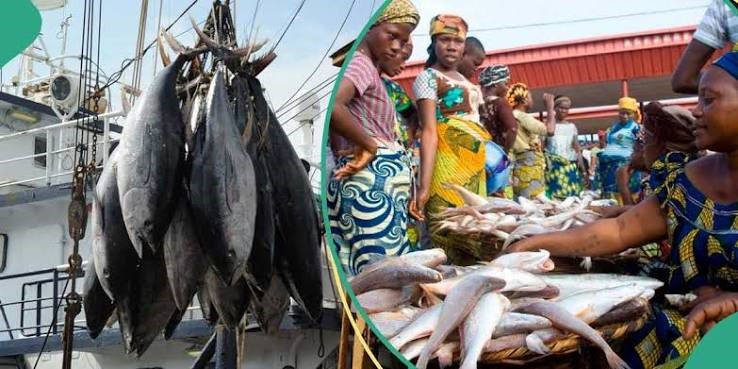
The report highlights a persistent gap in Nigeria’s fish sector: local production remains too low to satisfy national demand. Even with improvements in aquaculture and fisheries output, the country still depends on imports to fill a large portion of what households, processors and food businesses consume every year.
Official figures show why the shortfall matters. The Central Bank of Nigeria says fish provides about 40 percent of the country’s protein intake, yet total annual production is around 1.07 million metric tonnes, compared with demand of about 3.36 million metric tonnes, leaving a gap of roughly 2.5 million metric tonnes. More recent reporting says domestic output rose to about 1.4 million metric tonnes in 2025, but that still leaves the country well below what is needed.
That deficit has real economic consequences. Nigeria spends heavily on fish imports to cover the shortfall, which drains foreign exchange and weakens efforts to build a more self-reliant food system. For consumers, the gap can also push prices upward, making fish less affordable for low- and middle-income households that rely on it as a major source of protein.
The reasons behind the production gap are familiar. Fish farming and capture fisheries in Nigeria face challenges such as high feed costs, limited access to finance, poor infrastructure, insecurity in some fishing areas and weak cold-chain systems that cause post-harvest losses. These bottlenecks make it difficult for local producers to scale up fast enough to match rising demand from a growing population.
Government and sector stakeholders have been trying to close the gap through the blue economy agenda, aquaculture support and import-substitution efforts. The CBN has previously backed fishery development initiatives aimed at boosting production, improving local supply and reducing import bills. More recent statements from the Marine and Blue Economy ministry suggest that output is improving, but the country still has a long way to go before it can become self-sufficient.
The article also underscores a broader food-security issue. Because fish is one of the cheapest and most widely consumed animal proteins in Nigeria, supply shortages have a direct effect on nutrition, especially in households that cannot easily switch to more expensive alternatives like meat. In that sense, increasing local fish production is not just an industry issue; it is also a public-health and affordability issue.
For Nigeria to narrow the gap, stakeholders will likely need to focus on feed affordability, hatchery support, better extension services, infrastructure for storage and transport, and investment that helps small and medium-scale fish farmers expand. Without that, local production may continue to improve in absolute terms but still fall short of the country’s rising consumption needs.
Sponsored

Related stories
 Agriculture
Babalola’s Farmer Support Hits N98m
Legal icon Aare Afe Babalola has disbursed N11.2 million to 81 outstanding farmers across Ekiti State's 16 local government areas, bringing total awards under his annual agricultural scheme since 2015 to N98 million.
 Agriculture
FG Launches African Swine Fever Control Campaign in Southwest
The Federal Government has launched a major African Swine Fever control and biosecurity campaign at the Oke-Aro Pig Farm Estate, distributing protective kits to farmers and pledging comprehensive training to prevent future outbreaks. The intervention by the Livestock Productivity and Resilience Support Project (L-PRES) targets one of Nigeria's largest pig production clusters, which has suffered devastating losses from the highly contagious disease in the past.
 Agriculture
Kyari: More Farmland Won’t Feed 400 Million Nigerians
Agriculture Minister Abubakar Kyari says Nigeria must treat agricultural extension as critical infrastructure, disclosing that over 100,000 farmers already receive weekly digital advisories as the country's population heads toward 400 million by 2050.
 Agriculture
Farmland Expansion Alone Won’t Feed Nigeria
Agriculture Minister Abubakar Kyari says Nigeria must shift to demand-driven, AI-enabled agricultural extension services to boost farm yields, warning that expanding farmland alone can no longer feed the country's growing population.
Comments (0)
Leave a comment
All comments are moderated before publishing. Your email is never published.