
IHS Nigeria Donates Equipment to Empower People With Disabilities
IHS Nigeria has donated business support equipment to persons with disabilities in Abuja’s Karonmajiji community, using an asset-based model designed to promote self-reliance, entrepreneurship and lasting livelihood support.
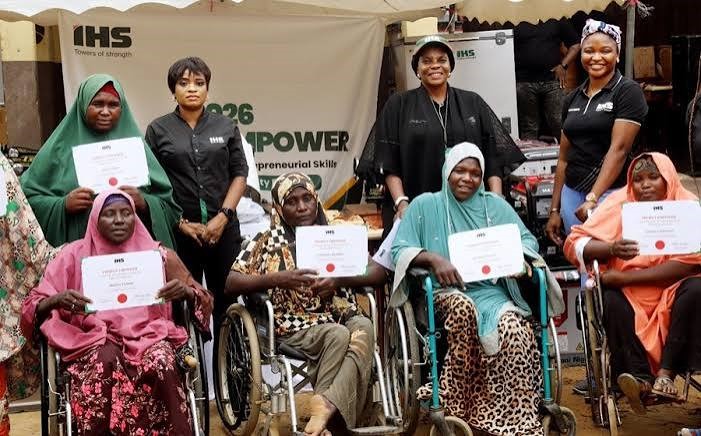
IHS Nigeria has donated business support equipment to people with disabilities in the Karonmajiji community of the Federal Capital Territory as part of its Project Empower initiative. The intervention is aimed at helping beneficiaries build sustainable livelihoods rather than relying on one-off financial handouts.
According to the company, the donation reflects a commitment to inclusive community development and long-term economic support. Speaking at the event, Titilope Oguntuga, Director of Sustainability at IHS Nigeria, said the initiative is designed to equip persons with disabilities with the tools and opportunities they need to build resilient livelihoods and participate more fully in local economic life.
The company said it deliberately chose an asset-based approach instead of short-term cash assistance. Under the programme, IHS Nigeria donated 50 pieces of business support equipment, including sewing machines, freezers, generators and hairdressing kits, to selected beneficiaries. The idea is that when people receive productive tools rather than temporary relief, they are better placed to generate income, support their families and grow small businesses over time.
That approach is important in a country where persons with disabilities often face a double burden of economic exclusion and social stigma. Many PWDs struggle to access formal employment, credit, mobility support and training, which makes entrepreneurship a practical pathway to independence. By providing tools that match specific trades, the intervention gives beneficiaries a chance to turn skills into income.
IHS Nigeria said the initiative also aligns with global development goals, particularly the United Nations Sustainable Development Goals on poverty reduction, decent work and reduced inequalities. Those goals are closely linked in practice: if people can start earning through small businesses, they are less likely to remain trapped in poverty and more likely to participate in their communities as active economic actors.
Project Empower has been one of IHS Nigeria’s main community support platforms. The company has used it to back skills acquisition and entrepreneurship-oriented interventions in different parts of the country, showing a shift in corporate social responsibility from charity toward capacity-building. In that sense, the Karonmajiji intervention fits into a broader strategy of giving communities assets they can use, maintain and build.
The donation also adds to IHS Nigeria’s wider history of social investment. The company has previously supported education, health and emergency response projects through partnerships with UNICEF and other organisations. Those projects include medical oxygen plants, internet connectivity for public schools and support for flood victims, suggesting that the company’s development work now spans multiple sectors rather than a single type of intervention.
For the beneficiaries in Karonmajiji, the practical benefit is immediate. A sewing machine can become the basis of a tailoring business, a freezer can support food sales or cold storage services, a generator can keep a small enterprise running through power outages, and hairdressing kits can help launch or expand a salon. Small pieces of equipment can have outsized effects when they are matched with existing skills and local demand.
The intervention also sends a broader message about inclusion. Too often, people with disabilities are treated only as recipients of aid, not as entrepreneurs or contributors to the economy. By focusing on livelihood tools, IHS Nigeria is recognising that disability inclusion should not stop at accessibility; it should also include productive opportunity.
That matters in a community context because the success of such a programme depends not only on the value of the items given out but also on follow-up support, training and market access. Beneficiaries may still need mentoring, business advice, community acceptance and a stable environment to turn the equipment into a viable income stream.
The event in Abuja therefore sits at the intersection of social responsibility and economic empowerment. It is a reminder that corporate interventions can be more effective when they help people build something durable instead of simply cushioning hardship for a short time. If the beneficiaries are able to sustain their businesses, the impact of the donation could extend well beyond the handover ceremony and into long-term household stability.
Sponsored

Related stories
 Youth Empowerment
TAFTA Trains 150 Female Creators to Build Sustainable Careers
, tools, and industry connections through its maiden Creator HQ programme, a three-day immersive training focused on content creation, intellectual property protection, and monetisation. Supported by the Mastercard Foundation, the initiative is designed to help women turn their creative talents into sustainable businesses and long-term careers.
 Youth Empowerment
Dangote Foundation Gives Students Free Shares
The Aliko Dangote Foundation has launched a Student Share Grant Initiative that will fund an additional 10 shares in the Dangote Petroleum Refinery IPO for eligible tertiary students who subscribe for a minimum of 10 shares in their own names. Chairman Aliko Dangote says the programme is about developing a mindset — equipping young Nigerians with the knowledge and opportunity to understand how economic value is created and how they can participate in it.
 Youth Empowerment
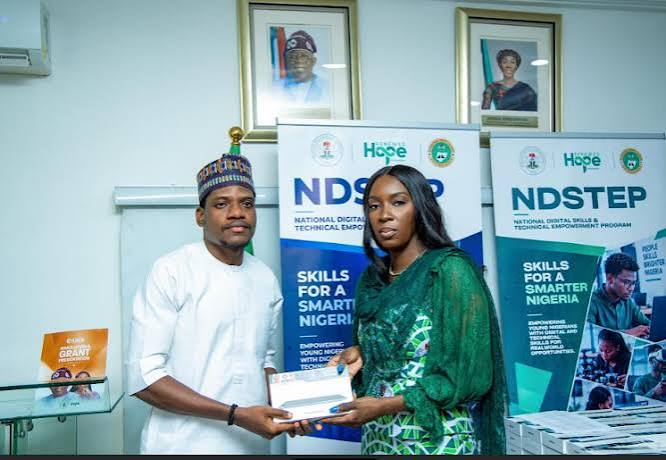
FG Empowers 70 Media Managers With Tablets
The Office of the Senior Special Assistant to the President on TVEE has given tablets to 70 digital media personnel to strengthen awareness of government vocational and entrepreneurship programmes ahead of the NPRGS Oyo State rollout.
 Youth Empowerment
MSS Academy Graduates 56 Youths in Event Technology
The Mobile Screen and Sound (MSS) Limited Technical Academy has graduated 56 students from its 10-week training programme in sound engineering, lighting design, and stage production, as part of efforts to equip young Nigerians with employable skills and reduce youth idleness. The academy has also promised automatic employment for the best five graduating students, underscoring its commitment to bridging the gap between training and industry placement.
Comments (0)
Leave a comment
All comments are moderated before publishing. Your email is never published.