
Japanese Doctors Shield Patient with Their Bodies as 7.1 Magnitude Earthquake Hits Mid-Surgery
Newly released hospital security footage shows medical staff at Kumamoto General Hospital in Japan shielding a patient with their bodies as a powerful earthquake shook the operating theatre, with all four ongoing surgeries successfully completed.
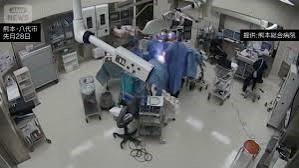
Dramatic security camera footage has emerged showing the moment doctors and medical staff at a hospital in Kumamoto, Japan, shielded a patient with their own bodies as a powerful earthquake struck the facility mid-surgery last month.
The footage, released by Kumamoto General Hospital and reported by the BBC, captures medical workers struggling to maintain control of an operating table as the theatre shook violently during the earthquake, which hit on July 28. According to the hospital, four separate surgeries were underway at the facility at the exact moment the quake struck.
In the clip, filmed inside one of the operating rooms where an abdominal surgery was in progress, medical equipment can be seen swaying violently as overhead lights flickered on and off from the force of the tremor. Two medical workers are seen holding down the operating table and using their own bodies to shield the patient from falling debris and shifting equipment, while other staff members scrambled to secure loose instruments and maintain order in the chaotic scene.
At one point in the footage, a member of the medical team is thrown to the floor while attempting to secure equipment that had been sent flying across the room by the force of the shaking. Despite the disruption, another staff member is seen opening a door during the tremor, a move aimed at ensuring an evacuation route remained accessible should the situation have escalated further.
Remarkably, despite the intensity of the earthquake, the surgical team did not abandon the procedures underway. According to the hospital, medical staff continued working through the shaking and went on to successfully complete all four surgeries that were in progress at the time.
The earthquake that struck Kumamoto was initially reported by Japanese media with a magnitude of 7.1, a scale of tremor capable of causing significant structural damage and widespread disruption. The quake caused substantial shaking across parts of the surrounding region, prompting safety concerns at hospitals, schools, and other public facilities in the affected areas.
In the aftermath of the earthquake, Kumamoto General Hospital was forced to temporarily suspend some of its services as staff assessed the facility for damage and worked to restore normal operations. The hospital confirmed that it resumed normal outpatient services on August 5, more than a week after the earthquake struck, suggesting the disruption to hospital operations, while significant, was not permanent.
The footage has since drawn widespread attention on social media, with many commending the composure and professionalism displayed by the surgical team under extremely dangerous circumstances. Videos of natural disasters striking hospitals and other critical facilities often draw strong public reactions, given the heightened stakes involved when patients are in the middle of medical procedures and unable to be moved quickly to safety.
Japan remains one of the most seismically active countries in the world, sitting along the Pacific Ring of Fire where multiple tectonic plates meet. The country has a long history of building resilience into its infrastructure, including hospitals, in anticipation of powerful earthquakes, given the frequency with which such events occur across the archipelago. Kumamoto Prefecture, where this latest earthquake struck, has previously experienced other significant seismic activity, making disaster preparedness training a standard part of operations for hospitals and other critical facilities in the region.
The successful completion of all four surgeries despite the earthquake has been held up as an example of the kind of emergency preparedness training that Japanese medical institutions routinely undergo, given the constant risk of seismic activity across the country. While the incident caused understandable alarm both inside the hospital and among the wider public who later viewed the footage, no casualties or serious injuries were reported among either patients or staff as a direct result of the earthquake at the facility.
Sponsored

Related stories
 Health
Borno Hires 2,000 Health Workers, Still Faces Staff Shortage
Borno State has recruited nearly 2,000 doctors, nurses and other health professionals in two years, but the head of its contributory health agency says manpower gaps persist as demand grows under the state health insurance scheme.
 Health
Lassa Fever Kills 268 in Nigeria as Cases Hit 1,138
Nigeria has recorded 1,138 confirmed Lassa fever cases and 268 deaths across 24 states in 2026, with the case fatality rate rising to 23.6 per cent—significantly higher than the 18.6 per cent recorded during the same period in 2025. The NCDC has identified five states accounting for 88 per cent of all confirmed cases, as it intensifies preparedness efforts ahead of the peak transmission season.
 Health
MSF Calls for Routine Noma Surveillance in Nigeria
Doctors Without Borders says noma, a fast-moving and often fatal facial infection linked to malnutrition and poverty, remains largely missing from Nigeria's routine child health programmes despite its 2023 recognition as a neglected tropical disease.
 Health
Oyo Rejects Diphtheria Outbreak Claims, Accuses APC
The Oyo State Government has dismissed claims by the Senator Sharafadeen Alli Campaign Organisation that diphtheria has affected 16 local government areas, describing the allegation as false and politically motivated. Commissioner for Health Dr. Oluwaserimi Ajetunmobi confirmed that while suspected cases have been recorded in 10 LGAs, none have been confirmed, and accused the APC campaign group of distorting immunisation data to score political points.
Comments (0)
Leave a comment
All comments are moderated before publishing. Your email is never published.