
India Unveils Plan to Help Nigeria Cut Post-Harvest Losses by Half, Deepen Farm Sector Ties
India has proposed a wide-ranging agricultural partnership with Nigeria covering technology transfer, dairy farming, food processing and climate-smart practices, aimed at slashing the nearly 50 per cent of produce Nigeria loses after harvest.
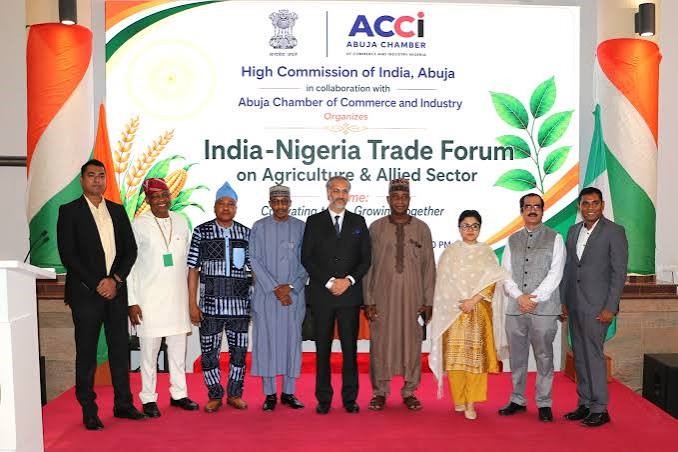
India has unveiled an ambitious plan to support Nigeria's drive for food security by helping the country slash post-harvest losses estimated at nearly 50 per cent, modernise livestock production, and strengthen food processing, in a move that could significantly boost bilateral agricultural cooperation between the two nations.
The initiative, which comes as Nigeria continues to grapple with soaring food prices, declining agricultural productivity, and mounting food insecurity, includes plans for technology transfer, climate-smart farming, mechanisation, financing, and capacity building aimed at transforming the country's agricultural value chain from farm to market.
Indian High Commissioner to Nigeria, Ambassador Abishek Singh, disclosed the plan on Thursday at the India-Nigeria Trade Forum on Agriculture and Allied Sector held in Abuja, an event organised by the Indian High Commission in partnership with the Abuja Chamber of Commerce and Industry (ACCI).
Speaking under the theme "Cultivating Trade, Growing Together," Singh said Nigeria possesses enormous agricultural potential but continues to lose nearly half of what its farmers produce due to inadequate storage, poor processing capacity, weak logistics, and inefficient value chains. He noted that India, which transformed itself from a food-deficit nation into one of the world's largest agricultural producers through targeted use of technology and innovation, was prepared to deploy that same expertise to help Nigeria reverse similar trends.
According to Singh, Nigeria's agriculture sector contributes significantly to the country's GDP, and India stands ready to invest specifically in livestock, fisheries, and food processing to help strengthen food security. He added that India would support Nigeria in adopting climate-resilient farming practices designed to help local farmers better withstand the growing impact of climate change on food production.
The envoy highlighted India's global leadership in drip irrigation technology, high-yield oil palm seedlings, and fertiliser production, arguing that these innovations could substantially improve farm productivity and reduce production costs across Nigeria's agricultural sector. He further noted that India's strengths in tomato processing, cold-chain logistics, food preservation, and modern packaging align closely with Nigeria's urgent need to reduce post-harvest waste and improve value addition across its produce chains.
Beyond crop production, Singh announced that Indian technology companies and agritech startups are prepared to partner with Nigerian institutions to provide digital solutions, technical training, and investment support. He explained that financing for such partnerships could be facilitated through institutions including the Nigerian Export-Import Bank (NEXIM), the Bank of Industry, and private-sector investors interested in the agricultural space.
In the livestock sector specifically, Singh said India would offer technical expertise aimed at improving dairy farming through artificial insemination, better breeding techniques, and cooperative models designed to boost milk and meat production nationwide. He disclosed that India is already collaborating with Jigawa State to modernise livestock production, introducing improved breeding programmes and helping organise farmers into dairy cooperatives as part of that ongoing partnership.
The High Commissioner further revealed that India has already forwarded a proposed Memorandum of Understanding (MoU) on agriculture and allied sectors to the Federal Government, urging Nigerian authorities to expedite its approval in order to unlock wider areas of bilateral cooperation.
Nigeria's Minister of Agriculture and Food Security, Senator Abubakar Kyari, welcomed the proposal, reaffirming the Federal Government's commitment to expanding agricultural partnerships under President Bola Tinubu's Renewed Hope Agenda. Represented at the forum by the Director of Agribusiness and Marketing Development in the ministry, Olawumi Olajide, the minister said government remained committed to leveraging strategic international partnerships to drive agricultural transformation, adding that collaboration with India would create jobs, promote value addition, facilitate technology transfer, and strengthen Nigeria's broader quest for food self-sufficiency.
Also speaking at the forum, the First Deputy President of the Abuja Chamber of Commerce and Industry (ACCI), Professor Adesoji Adesugba, described the event as a major step toward strengthening economic relations between both countries through agriculture. Adesugba, who also serves as National Vice President (India) of the Nigerian Association of Chambers of Commerce, Industry, Mines and Agriculture (NACCIMA), said the engagement would unlock opportunities in mechanisation, research, innovation, agro-processing, and technology transfer, stressing that stronger Nigeria-India agricultural cooperation could accelerate economic diversification while improving food production and rural livelihoods.
The renewed partnership comes at a critical time for Nigeria, where food inflation remains one of the biggest drivers of the rising cost of living. Despite possessing more than 70 million hectares of arable land, the country continues to struggle with low productivity, limited mechanisation, insecurity in farming communities, poor storage infrastructure, and weak agro-processing capacity. Agricultural experts estimate that between 30 and 50 per cent of fruits, vegetables, grains, and other farm produce are lost annually before reaching consumers, losses running into billions of naira each year that reduce farmers' incomes, discourage investment, and worsen food shortages nationwide.
India's proposed intervention builds on decades of growing economic relations between Abuja and New Delhi, with India already ranking among Nigeria's largest trading partners across sectors including pharmaceuticals, energy, information technology, manufacturing, and agriculture. If fully implemented, the new agricultural partnership is expected to deepen those ties further, introducing technologies that helped power India's own agricultural transformation during and after its Green Revolution, while significantly reducing food losses, expanding agro-industrial processing, boosting dairy and livestock production, creating thousands of jobs across the value chain, and strengthening Nigeria's long-term food security objectives.
Sponsored

Related stories
 Agriculture
Babalola’s Farmer Support Hits N98m
Legal icon Aare Afe Babalola has disbursed N11.2 million to 81 outstanding farmers across Ekiti State's 16 local government areas, bringing total awards under his annual agricultural scheme since 2015 to N98 million.
 Agriculture
FG Launches African Swine Fever Control Campaign in Southwest
The Federal Government has launched a major African Swine Fever control and biosecurity campaign at the Oke-Aro Pig Farm Estate, distributing protective kits to farmers and pledging comprehensive training to prevent future outbreaks. The intervention by the Livestock Productivity and Resilience Support Project (L-PRES) targets one of Nigeria's largest pig production clusters, which has suffered devastating losses from the highly contagious disease in the past.
 Agriculture
Kyari: More Farmland Won’t Feed 400 Million Nigerians
Agriculture Minister Abubakar Kyari says Nigeria must treat agricultural extension as critical infrastructure, disclosing that over 100,000 farmers already receive weekly digital advisories as the country's population heads toward 400 million by 2050.
 Agriculture
Farmland Expansion Alone Won’t Feed Nigeria
Agriculture Minister Abubakar Kyari says Nigeria must shift to demand-driven, AI-enabled agricultural extension services to boost farm yields, warning that expanding farmland alone can no longer feed the country's growing population.
Comments (0)
Leave a comment
All comments are moderated before publishing. Your email is never published.