
FG Launches Fertiliser Support in Jigawa to Boost Farming and Curb Food Inflation
The Federal Government has moved to boost farming activities in Jigawa State by making cheap, subsidised fertiliser available to smallholder farmers,a targeted intervention aimed at raising yields, cushioning the impact of food inflation, and pulling rural households back from the brink of hunger. Officials say the programme is part of a broader national push to make Nigeria self-sufficient in food production, but farmers warn that without sustained supply, timely delivery, and credit support, t
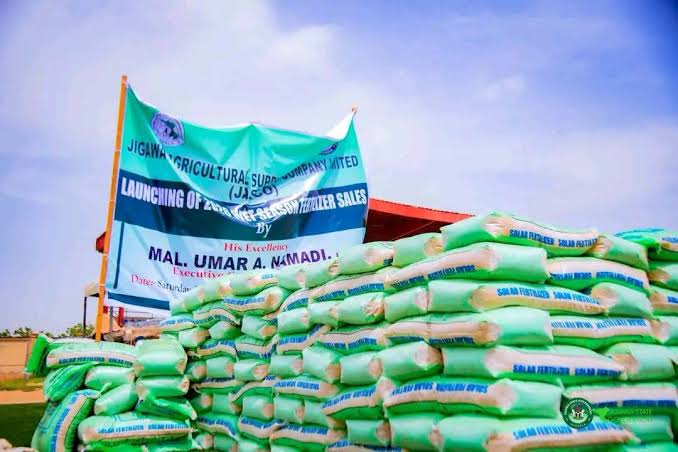
Federal Government has launched a targeted intervention to boost farming activities in Jigawa State, providing cheap and subsidised fertiliser to smallholder farmers in a bid to raise agricultural output, reduce food prices, and strengthen rural livelihoods in one of Nigeria’s most food-insecure regions.
The initiative, unveiled in Dutse, the Jigawa State capital, is part of a broader national push to make Nigeria self-sufficient in food production and to ease the burden of soaring food prices that have pushed millions of households deeper into poverty. Government officials said the distribution is designed to ensure that farmers who cannot afford commercial fertiliser—whose prices have climbed steeply in recent years receive the inputs they need to plant, cultivate, and harvest at scale.
The fertiliser is being sold at a fraction of the open-market price, with distribution channelled through state agricultural agencies and farmer associations to minimise hoarding, diversion, and the kind of middlemen exploitation that has undermined past subsidy schemes. Officials said the programme targets genuine farmers, prioritising those in rural communities where access to inputs is most limited and where the difference between a fertilised and unfertilised field can mean the difference between food security and hunger.
For Jigawa, the stakes are particularly high. The state is one of Nigeria’s agricultural heartlands, producing millet, sorghum, rice, groundnuts, wheat, and a range of vegetables. But productivity has historically lagged behind potential, constrained by the high cost of fertiliser, inadequate irrigation, poor storage infrastructure, and the growing impact of climate change. Many farmers have been forced to reduce the area they cultivate or abandon farming altogether because they cannot afford the inputs required to make a profit.
The fertiliser intervention is intended to address the cost barrier directly. By lowering the price of a critical input, the government hopes to encourage farmers to expand cultivated acreage, adopt improved agronomic practices, and invest in the productivity gains that drive income growth. If successful, the programme could increase yields, reduce post-harvest losses, and lower food prices—benefits that would ripple through households, markets, and the broader economy.
The timing is significant. Nigeria continues to grapple with food inflation that has eroded household purchasing power and pushed millions of people into acute food insecurity. Agricultural experts have repeatedly warned that without affordable inputs, the country’s food supply will remain fragile and dependent on imports an unsustainable position for a nation with Nigeria’s landmass, labour force, and agricultural potential. The Jigawa fertiliser programme is a recognition that food security begins with the farmer, the seed, and the soil—not with imports and emergency relief.
But the intervention also faces familiar risks. Subsidy programmes in Nigeria have been plagued by diversion, where fertiliser intended for smallholder farmers ends up in the hands of large-scale commercial operators or political cronies. Distribution delays have often meant that farmers receive inputs after the planting window has closed, rendering them useless. And without complementary support—irrigation, extension services, access to credit, and market linkages cheap fertiliser alone cannot transform agricultural productivity.
Officials have promised that the Jigawa rollout will be transparent, with beneficiary lists verified through farmer associations and local government structures, and with monitoring mechanisms to ensure that the fertiliser reaches those for whom it is intended. They have also urged farmers to use the inputs responsibly, combining fertiliser with good agronomic practices such as timely planting, proper spacing, and weed control to maximise returns.
For farmers in Jigawa, the intervention is a welcome reprieve but not a complete solution. Many say they need more than cheap fertiliser: they need affordable seeds, reliable irrigation, better roads to transport produce to markets, and protection from the insecurity that has disrupted farming in parts of northern Nigeria. Some have also called for access to credit, arguing that even subsidised inputs require upfront cash that many smallholders do not have.
The broader challenge for the Federal Government is to ensure that the Jigawa programme is not an isolated gesture but part of a coherent, sustained agricultural transformation strategy. Cheap fertiliser can raise yields for a season; sustained investment in rural infrastructure, research and extension, irrigation, and market access can raise productivity for a generation. The difference between the two is the difference between a harvest and a habit between temporary relief and lasting food security.
For now, the fertiliser is moving, the farmers are planting, and the fields are green with possibility. Whether Jigawa’s harvest will justify the promise will depend not only on what is distributed this season, but on whether the government sustains the commitment in the seasons to come.
Sponsored

Related stories
 Agriculture
Poor Harvest May Worsen Nigeria's Food Crisis, AFAN Warns
The All Farmers Association of Nigeria has warned that poor harvests caused by devastating floods, insecurity and farmer displacement could plunge the country into a severe food crisis, with millions facing famine-like conditions in early 2027. AFAN President Kabir Ibrahim says the situation could mirror the 2024 hardship protests unless urgent interventions are made to support farmers and stabilise food production.
 Agriculture
Abakaliki Rice Mill: Ebonyi’s N171bn Neglected Goldmine
Nigeria's largest rice mill, operating since 1967, processes 132,000 tonnes of rice annually—worth over N171 billion—yet operates without power, safe working conditions, or good roads. As the state's entire IGR sits at just N17.18 billion, analysts ask how a facility generating ten times that amount has been allowed to decay into a "prostrate goldmine."
 Agriculture
Seaweed Could Transform Nigeria’s Agricultural Energy Sector
SMEFUNDS CEO Dr. Femi Oye advocates for seaweed as a renewable energy source to power Nigeria’s food production, offering a circular solution for farmers and small businesses.
 Agriculture
Babalola’s Farmer Support Hits N98m
Legal icon Aare Afe Babalola has disbursed N11.2 million to 81 outstanding farmers across Ekiti State's 16 local government areas, bringing total awards under his annual agricultural scheme since 2015 to N98 million.
Comments (0)
Leave a comment
All comments are moderated before publishing. Your email is never published.