
Ekiti Trains 30 Officers on Livestock Insemination
Ekiti State has trained 30 officers as Artificial Insemination Technicians under the L-PRES initiative, targeting 850 cows and 150 goats to boost livestock productivity and genetic quality
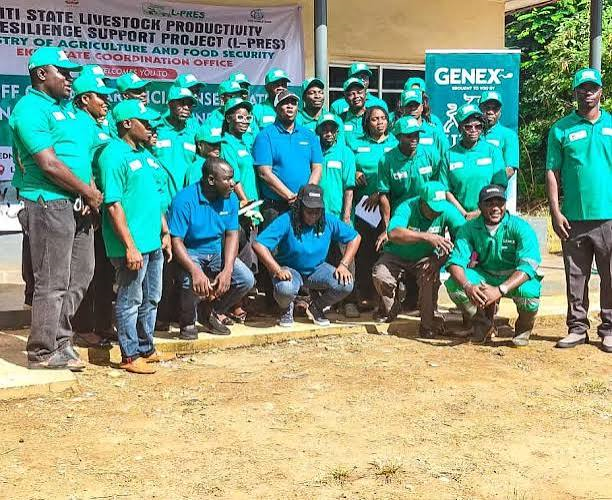
In a strategic move to revolutionize the state’s agricultural sector and enhance food security, the Ekiti State Government has initiated a comprehensive training programme for 30 officers to become certified Artificial Insemination (AI) Technicians. The initiative, spearheaded by the Livestock Productivity and Resilience Support Project (L-PRES), marks a significant shift toward modernizing livestock production and improving the genetic quality of local ruminant breeds.
The programme was officially flagged off in Ado Ekiti on Friday, with the State Commissioner for Agriculture and Food Security, Ebenezer Boluwade, charging livestock farmers and agribusiness entrepreneurs to fully embrace modern breeding techniques. He emphasized that the state government remains deeply committed to supporting the agricultural value chain through strategic investments, capacity building, and institutional strengthening.
“The artificial insemination programme was designed by the state L-PRES for breed and genetic improvement, as well as the multiplication of livestock for better production,” Commissioner Boluwade stated during the induction ceremony. He revealed that the current phase of the project specifically targets the artificial insemination of 850 cows and 150 goats across the state.
The decision to prioritize this intervention stems from critical gaps identified in the state’s livestock sector. According to recent agricultural surveys, livestock productivity among L-PRES beneficiary farmers in Ekiti has been historically characterized by poor genetic quality and limited access to improved breeding services. These deficiencies have directly resulted in low milk yields, stunted growth rates, and diminished market value for local farmers, thereby constraining their economic potential and livelihood sustainability.
To address these systemic challenges, the government is focusing on developing a sustainable, homegrown workforce of AI experts. The 30 professionals selected for the intensive training are drawn primarily from the state’s Animal Husbandry and Veterinary Departments. The objective is not merely to execute the immediate insemination targets, but to cultivate a cadre of master trainers who can ensure the long-term transmission of these critical skills within the state.
“It is important to raise personnel that would acquire skills in artificial insemination technology, and most importantly, to develop experts in artificial insemination operations who can train others and ensure sustainability,” Boluwade explained. “At the end of this programme, I expect to see a marked genetic improvement in our local ruminant breeds that is capable of driving economic growth and improving livelihoods.”
The scientific basis for this initiative lies in the concept of hybrid vigor. By cross-breeding resilient local breeds with high-yielding exotic breeds that possess superior pedigrees, farmers can produce offspring with enhanced disease resistance, faster growth rates, and significantly higher milk and meat yields. This biological upgrade is expected to directly translate into increased household incomes and greater resilience against economic shocks for rural farming communities.
Adding a crucial layer of sustainability to the project, the Lead Consultant from Genex Urus Company, Olayiwola Adekunle, highlighted the long-term vision of the partnership. He noted that the primary goal of the exercise is to build indigenous capacity, eliminating the historical reliance on foreign experts for advanced agricultural services.
“This exercise is to ensure that we have citizens of Ekiti State who are able to perform artificial insemination independently, instead of importing personnel from other countries to do it,” Adekunle stated. To guarantee the continuity of this capacity-building effort, Genex Urus Company has committed to providing technical support and mentorship to the 30 newly trained and qualified inseminators for the next three years. This post-training support is a vital component of the L-PRES sustainability plan, ensuring that the technicians can confidently apply their skills in real-world scenarios.
The Ekiti State Government’s proactive approach to livestock development aligns with broader national objectives to reduce reliance on imported animal proteins and boost rural economies. By combining cutting-edge agricultural science with targeted human capital development, the state is laying a robust foundation for a modern, profitable, and sustainable livestock industry. As the 30 new technicians prepare to hit the field, the anticipation of a tangible transformation in Ekiti’s agricultural landscape has never been higher.
Sponsored

Related stories
 Agriculture
Abakaliki Rice Mill: Ebonyi’s N171bn Neglected Goldmine
Nigeria's largest rice mill, operating since 1967, processes 132,000 tonnes of rice annually—worth over N171 billion—yet operates without power, safe working conditions, or good roads. As the state's entire IGR sits at just N17.18 billion, analysts ask how a facility generating ten times that amount has been allowed to decay into a "prostrate goldmine."
 Agriculture
Seaweed Could Transform Nigeria’s Agricultural Energy Sector
SMEFUNDS CEO Dr. Femi Oye advocates for seaweed as a renewable energy source to power Nigeria’s food production, offering a circular solution for farmers and small businesses.
 Agriculture
Babalola’s Farmer Support Hits N98m
Legal icon Aare Afe Babalola has disbursed N11.2 million to 81 outstanding farmers across Ekiti State's 16 local government areas, bringing total awards under his annual agricultural scheme since 2015 to N98 million.
 Agriculture
FG Launches African Swine Fever Control Campaign in Southwest
The Federal Government has launched a major African Swine Fever control and biosecurity campaign at the Oke-Aro Pig Farm Estate, distributing protective kits to farmers and pledging comprehensive training to prevent future outbreaks. The intervention by the Livestock Productivity and Resilience Support Project (L-PRES) targets one of Nigeria's largest pig production clusters, which has suffered devastating losses from the highly contagious disease in the past.
Comments (0)
Leave a comment
All comments are moderated before publishing. Your email is never published.