
Chinese Ambassador Advocates Mandarin Teaching in Nigerian Schools as 2026 Marks Year of People-to-People Exchange
The Chinese Ambassador to Nigeria has called for broader Mandarin language instruction in Nigerian schools, describing the language as a gateway to global opportunities as both countries mark the China-Africa Year of People-to-People Exchange.
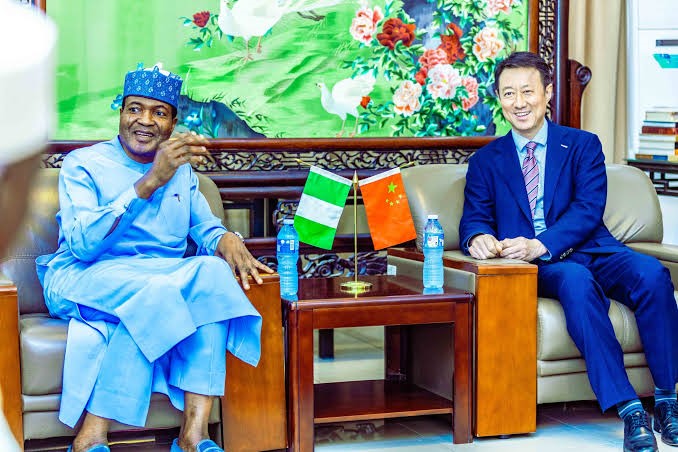
Chinese Ambassador to Nigeria has made a strong case for expanding Mandarin language teaching across Nigerian schools, emphasising that 2026 has been designated the China-Africa Year of People-to-People Exchange — a designation that places education and cultural cooperation at the very centre of the deepening bilateral relationship between both countries.
The ambassador made the advocacy during a visit to Grace Schools in Lagos, where she witnessed a demonstration of Mandarin proficiency by pupils who have been learning the Chinese language as part of the school's pioneering language curriculum. The envoy commended the pupils for their impressive command of the language and expressed optimism that more Nigerian students would go on to study and work in China as the two nations deepen their educational and cultural ties.
"I'm happy that the children are learning Chinese well. I love Nigeria. We have similar attire, and I enjoy moi moi, jollof rice and egusi," she said warmly.
Speaking further, the envoy noted that greater educational and cultural exchanges would strengthen relations between both countries and equip young Nigerians with global opportunities. She said 2026 had been designated the China-Africa Year of People-to-People Exchange, with education and cultural cooperation occupying a central place in bilateral relations.
The envoy said China would continue to support Nigerian students through scholarships, teacher and student exchange programmes, educational donations and other initiatives aimed at deepening mutual understanding.
The Chinese government has in recent years significantly expanded its educational footprint in Nigeria, donating teaching materials, establishing Chinese cultural corners in secondary schools across the FCT and other states, and offering hundreds of scholarship opportunities annually for Nigerian students to study in Chinese universities.
The Federal Capital Territory Education Secretariat has also been preparing to roll out Mandarin language programmes in public schools, expanding a network of Chinese cultural centres already operating within selected secondary schools.
The Chief Executive Officer of Grace Schools, Mrs Olatokunbo Edun, said the school introduced Mandarin in 2010 after recognising China's growing economic influence and the opportunities it presents for young Nigerians. She said Mandarin is taught from Nursery Two to Senior Secondary School II, with many pupils now able to read, write and converse fluently in the language.
According to Edun, proficiency in Mandarin gives students a competitive advantage in the labour market. "Even if you have a degree, you may not get a job. But if you speak Mandarin, the job is yours. We are trying to prepare our children for the global workplace from an early age," she said.
She disclosed that one of the school's pupils had already attained HSK Level 3, an internationally recognised Chinese language proficiency qualification, at the age of six.
The advocacy of the Chinese envoy builds on a broader policy shift already underway at the national level. The Chinese language, Mandarin, has officially been included as one of the foreign languages to be taught in senior secondary schools across Nigeria, following a recent review of the national curriculum.
Chinese will now be offered alongside French and Arabic as part of the foreign language options available to students. Education officials explained that Mandarin will be optional, not compulsory, giving students the chance to choose it as an international language. They added that the inclusion is aimed at helping students develop skills and cultural knowledge that could improve their global competitiveness.
The Nigerian Educational Research and Development Council confirmed in a circular dated September 8, 2025, that implementation of the new curriculum would begin with the 2025/2026 academic session.
The initiative comes as Chinese companies increase investments across Nigerian infrastructure, manufacturing, mining, telecommunications and energy projects, creating growing demand for workers familiar with Chinese language and business practices. China remains one of Nigeria's largest sources of infrastructure financing and engineering expertise, with Chinese-backed projects spanning railways, airports, power facilities and industrial zones.
The Chinese Corner is an educational and cultural centre sponsored by China Civil Engineering Construction Corporation as part of its corporate social responsibility. With 14 such centres now operational across the FCT, the network provides free Mandarin lessons, cultural programming, and pathways to Chinese scholarship opportunities for thousands of Nigerian secondary school students.
As one official noted during an earlier inauguration ceremony, "Chinese Mandarin has the largest number of speakers in the world, and today it has become the language of commerce, education, and tourism. Our decision to delve into Chinese education and culture is a wise move."
For investors and policy watchers, the programme signals the continued institutionalisation of Nigeria-China relations beyond infrastructure financing and commodity trade, extending into education, workforce development and long-term economic integration. Students who excel in the programme will qualify for scholarships and academic exchanges in China, potentially expanding the talent pipeline between both countries.
The Ambassador's visit and advocacy signal that China views linguistic and cultural exchange as equally strategic to its economic investments in Nigeria — a philosophy that, if embraced fully by Nigerian education planners, could produce a generation of bilingual professionals uniquely positioned to navigate the opportunities created by one of the world's most consequential South-South bilateral relationships.
Sponsored

Related stories
 Tech & Education
Bamidele Unveils N200m Renovated Science College
Senate Leader Opeyemi Bamidele has commissioned the renovated Government Science College, Iyin-Ekiti, personally funded at over N200 million, donating buses to the school and nearby FUTESI while promising a second phase of upgrades.
 Tech & Education
Abia Students Crowned Global Debate Champions
Students from public schools in Abia State, representing Nigeria, have emerged overall champions at the 2026 International Schools Debate Championship in Doha, Qatar, winning four major trophies and 12 laurels after defeating teams from Jordan, India, Qatar, the Philippines, Kenya and others. The historic victory has been hailed as proof that Governor Alex Otti's education reforms are producing world-class scholars.
 Tech & Education
WAEC Appoints Suleiman Kum as New Head of Nigeria National Office
The West African Examinations Council has appointed 56-year-old Suleiman Danlami Kum as the new Head of the Nigeria National Office, succeeding Dr Amos Josiah Dangut, who has assumed office as the council’s Registrar and Chief Executive Officer. A seasoned test developer, administrator and executive with 28 years of service, Kum is expected to drive technological innovation and examination security across Nigeria’s foremost examinations body.
 Tech & Education
Emmanuel College ’88 Set Renovates Classrooms, Pays Exam Fees
The Progressives of the Unique 1988 Set of Emmanuel College Owerri have unveiled a renovated five-classroom block and paid NECO and WAEC fees for financially disadvantaged students at their alma mater.
Comments (0)
Leave a comment
All comments are moderated before publishing. Your email is never published.