
FG Launches iDICE Digital Skills Programme Targeting 50,000 Young Nigerians
The Federal Government has launched the iDICE Skills Training to Jobs Programme, targeting 50,000 young Nigerians across seven North-West states with training in AI, cybersecurity, data analytics and creative industries. Backed by international development partners, the 10–18 week programme aims to connect graduates to jobs, internships and businesses, with 50% female participation and a broader national target of 300,000 beneficiaries.

Federal Government has commenced training for 50,000 young Nigerians across the seven North-West states under its Skills Training to Jobs Programme, a flagship initiative of the Investment in Digital and Creative Enterprises (iDICE) programme, marking one of the largest single mobilisations of youth for digital and creative skills development in the country’s history.
The training, which began on November 16, 2026, follows a recruitment exercise conducted between September 1 and October 9, 2026, covering Kano, Kaduna, Katsina, Kebbi, Jigawa, Sokoto, and Zamfara States. The 50,000 participants were selected through an evaluation process after the recruitment exercise, and the programme will run for between 10 and 18 weeks across three tiers: basic, intermediate, and advanced.
The curriculum is deliberately aligned with the demands of the modern economy. Participants will receive training in artificial intelligence and machine learning, cybersecurity, cloud engineering, software engineering, data analytics, user interface and user experience design, 3D animation, content creation, social media management, and graphic design. The programme also covers fashion design, culinary arts, and food production, reflecting an understanding that the creative economy is not a peripheral sector but a core component of Nigeria’s economic future.
The initiative is co-financed by the African Development Bank, the Agence Française de Développement, the Islamic Development Bank, and the Bank of Industry, which also serves as the executing agency. In the North-West, the programme is being delivered by Conclase Consulting Limited through its StacStart platform as the implementing partner.
Minister of Information and National Orientation, Mohammed Idris, framed the mobilisation as evidence of the government’s commitment to translating youth empowerment from rhetoric into tangible opportunity. "Mobilising 50,000 young Nigerians across the North-West is proof that this administration’s commitment to youth empowerment is translating into real opportunity," he said. "These young people will not be trained and left to find their own way. Every step of this programme is built to lead to jobs and enterprise".
The programme’s design reflects a lesson learned from decades of failed skills interventions: training without a pathway to employment is merely a ceremony. Organisers say participants will receive support towards employment through internship placements, job placements, and certificates upon successful completion of the training. Adamson Victor, Communications and Public Relations Manager at StacStart, said the initiative would extend beyond skills acquisition to support participants’ transition into employment and enterprise.
The Bank of Industry, as executing agency, has emphasised the North-West’s economic potential. Dr Olasupo Olusi, Managing Director and Chief Executive Officer of BOI, identified fintech, agritech, digital commerce, film, fashion, and textiles as sectors where the region has significant potential, adding that the programme is designed to "support young Nigerians to develop skills that can unlock opportunities in these sectors, strengthen local enterprises and contribute to job creation".
The programme targets 50 per cent female participation and includes young people who are not in employment, education, or training, as well as persons with disabilities. That inclusivity is significant in a region where women’s access to digital skills training has historically been constrained by cultural and economic barriers.
Damilola Abudu, Programme Director for the iDICE Skills Training to Jobs Programme in the North-West at Conclase Consulting Limited, said the recruitment and screening processes involved careful coordination across the seven states. "Our focus now is making sure every one of the 50,000 participants has a smooth start on 16 November and a clear path to jobs and enterprise opportunities," Abudu said.
Adeposi Bamiduro, Chief Executive Officer of Conclase Consulting Limited and StacStart, framed the programme as a bridge between skills acquisition and employment. "Our focus has always been to connect skills training with real employment and business opportunities," he said.
The North-West mobilisation is part of a broader national architecture. The iDICE Skills to Jobs Programme aims to train 50,000 participants in each of Nigeria’s six geopolitical zones, for a total of 300,000 young Nigerians. Similar cohorts have been mobilised in the South-West, where training commenced on November 18, and the North-Central, with applications already opened.
For Nigeria, the stakes are difficult to overstate. Youth unemployment remains one of the country’s most persistent and dangerous challenges, and the digital economy offers a rare opportunity to absorb large numbers of young people into productive work. The iDICE programme is not a guarantee of success. But with its emphasis on job placement, internship pathways, and enterprise support, it is at least designed to avoid the familiar trap of training without a destination. The 50,000 young people who began their classes this week are the first test of whether that design can deliver.
Sponsored

Related stories
 Youth Empowerment
SMEDAN, Abbas Launch Initiative to Empower 10,000 Students in Kaduna
SMEDAN, in partnership with House Speaker Rt. Hon. Tajudeen Abbas, has disbursed grants to about 10,000 indigent tertiary students in Kaduna State to ease educational costs and promote entrepreneurship. With beneficiaries confirming receipt, the initiative aims to turn financial support into a pathway for building future entrepreneurs and employers.
 Youth Empowerment
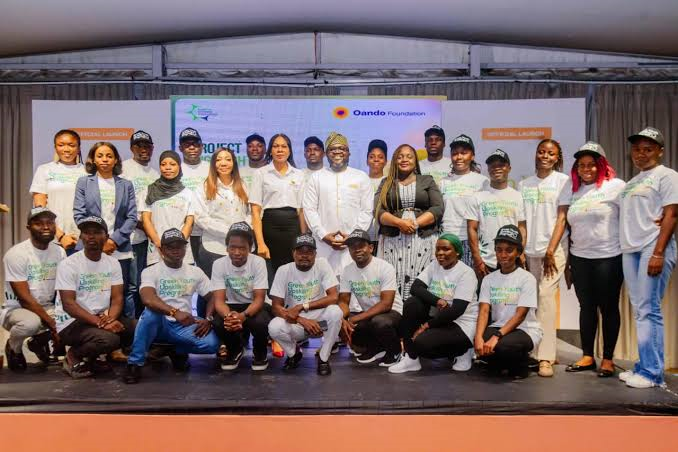
Foundation Launches Youth Empowerment Programme Targeting 5,000 Nigerians
A Nigerian foundation has unveiled a sweeping plan to empower 5,000 young people with skills, funding, and mentorship, targeting a generation battered by unemployment and economic hardship. The initiative arrives at a critical moment: with youth unemployment soaring and millions of graduates unable to find work, the programme promises not just training but a pathway to self-reliance. But the question that haunts every such intervention is whether it can scale beyond a lucky few and deliver lasti
 Youth Empowerment
Katung Empowers Southern Kaduna Women, Youths Through Traditional Crafts
Senator Sunday Marshall Katung has trained and empowered women and youths in Zonkwa, Zangon Kataf LGA, with vocational skills in ceramic and pottery, tie-and-dye, and bead-making,backed by start-up funds to turn craft into cash. It is the latest in a series of human-capital interventions from the Kaduna South lawmaker, and beneficiaries say the message is clear: promises are being translated into action, one skill at a time.
 Youth Empowerment
EU, GIZ Empower 1,000 Northeast Households with Business Kits
The SEPIN-SUSI programme has distributed business establishment kits to 1,000 vulnerable households across Adamawa and Borno States—550 in Numan and 450 in Kwaya Kusar,under a GIZ-implemented Graduation Approach backed by the European Union and Germany’s Federal Ministry for Economic Cooperation and Development. It is a deliberate shift from short-term relief to sustainable livelihoods, with beneficiaries trained in shoemaking, fishery, tailoring, catering, and poultry production.
Comments (0)
Leave a comment
All comments are moderated before publishing. Your email is never published.