
NPTF Launches Skills Acquisition Drive to Empower Police Families and Tackle Unemployment
The Nigeria Police Trust Fund, in partnership with POWA and the Nigeria Police Force, has launched a skills acquisition and empowerment programme for spouses of junior police officers, aiming to strengthen family welfare, create small businesses and reduce unemployment among police households.

The Nigeria Police Trust Fund (NPTF) has unveiled a new skills acquisition initiative targeted at the families of junior police officers, presenting it as both a welfare intervention and an economic empowerment strategy. The programme is designed to help spouses build sustainable livelihoods through vocational training, entrepreneurship support and start-up resources, while also improving the overall stability of police households.
The launch reflects a growing recognition within the police ecosystem that officer performance is closely tied to family well-being. By focusing on spouses, the initiative seeks to reduce financial pressure at home, ease dependence on a single income and create a more resilient support structure around serving officers. In practical terms, that means families should be better able to meet everyday needs, invest in small businesses and participate more fully in local economic activity.
According to the report, the programme is being run jointly by the NPTF, the Nigeria Police Force and the Police Officers’ Wives Association (POWA). That collaboration matters because it brings together institutional backing, welfare advocacy and grassroots reach. POWA’s involvement is especially important since it gives the programme a direct link to the women and households it is meant to serve, making the intervention more likely to match real family needs rather than generic training models.
The initiative is framed as part of the broader Renewed Hope agenda, which emphasises job creation, self-reliance and inclusive development. Rather than treating welfare as a passive cash-transfer issue, the NPTF is positioning empowerment as a long-term solution: if police families can earn income through small enterprises or vocational work, they are less vulnerable to hardship and less likely to be trapped in cycles of dependency.
The programme also responds to Nigeria’s wider unemployment challenge. Many households, including those linked to public service, struggle with rising living costs and limited opportunities for additional income. By giving spouses practical skills, the NPTF is trying to open pathways into areas such as tailoring, food processing, catering, beauty services, agribusiness, and other micro-enterprises that can be launched with modest capital. That approach is particularly useful in communities where formal employment is scarce but local markets still have room for small businesses.
Another important aspect of the initiative is its symbolism. Police welfare has often been discussed in terms of salaries, housing, uniforms and operational equipment, but this programme broadens the conversation to include family empowerment. That shift suggests a more holistic view of security: if the home front is stable, officers may be more focused and less distracted by domestic financial stress. The programme therefore links social welfare with institutional effectiveness.
The launch is also likely to be welcomed by families who have long felt that the burden of police service is shared by spouses in quiet but significant ways. Junior officers, in particular, often have limited income and high household responsibilities. A training-and-empowerment scheme gives their partners a chance to contribute economically and to develop personal agency, rather than remaining locked out of income-generating opportunities.
In effect, the NPTF initiative aims to do two things at once: improve livelihoods and strengthen policing. By investing in the people who support officers behind the scenes, the programme treats family welfare as a public-interest issue. If implemented well, it could become a model for how institutions can address unemployment not only through direct job creation, but through targeted support for dependants who are ready to work, learn and build small enterprises.
Sponsored

Related stories
 Youth Empowerment
TAFTA Trains 150 Female Creators to Build Sustainable Careers
, tools, and industry connections through its maiden Creator HQ programme, a three-day immersive training focused on content creation, intellectual property protection, and monetisation. Supported by the Mastercard Foundation, the initiative is designed to help women turn their creative talents into sustainable businesses and long-term careers.
 Youth Empowerment
Dangote Foundation Gives Students Free Shares
The Aliko Dangote Foundation has launched a Student Share Grant Initiative that will fund an additional 10 shares in the Dangote Petroleum Refinery IPO for eligible tertiary students who subscribe for a minimum of 10 shares in their own names. Chairman Aliko Dangote says the programme is about developing a mindset — equipping young Nigerians with the knowledge and opportunity to understand how economic value is created and how they can participate in it.
 Youth Empowerment
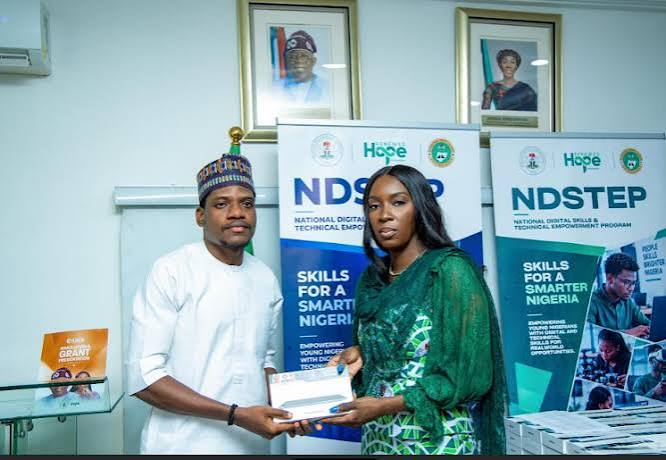
FG Empowers 70 Media Managers With Tablets
The Office of the Senior Special Assistant to the President on TVEE has given tablets to 70 digital media personnel to strengthen awareness of government vocational and entrepreneurship programmes ahead of the NPRGS Oyo State rollout.
 Youth Empowerment
MSS Academy Graduates 56 Youths in Event Technology
The Mobile Screen and Sound (MSS) Limited Technical Academy has graduated 56 students from its 10-week training programme in sound engineering, lighting design, and stage production, as part of efforts to equip young Nigerians with employable skills and reduce youth idleness. The academy has also promised automatic employment for the best five graduating students, underscoring its commitment to bridging the gap between training and industry placement.
Comments (0)
Leave a comment
All comments are moderated before publishing. Your email is never published.