
NGO Empowers 120 FCT Youths With Tech Skills
Givchris Global Services Limited has begun a six-month, free skills programme in Kwali, Abuja, training 120 young people aged 12 to 30 in computer hardware and mobile phone repairs to boost self-employment.

A non-governmental organisation, Givchris Global Services Limited, has begun a skills training and empowerment programme for 120 young people in the Federal Capital Territory (FCT), focused on computer hardware and mobile phone repairs.
The programme is supported by the Federal Ministry of Education and carried out in collaboration with the World Bank. It is designed to give participants practical, marketable technical skills so they can work for themselves and help reduce youth unemployment.
The initiative is implemented under the Innovation Development and Effectiveness in the Acquisition of Skills (IDEAS) Technical and Vocational Education and Training (TVET) programme, which aims to prepare young people for economic independence through hands-on training.
Speaking in Kwali, Abuja, at the weekend, the Executive Director of Givchris Global Services Limited, Mr Christian Nwachukwu, said the Federal Ministry of Education established the programme with funding support from the World Bank to tackle youth unemployment by equipping participants with skills that can translate into sustainable livelihoods.
Nwachukwu explained that the programme originally provided for 100 trainees, but his company increased the number to 120 and took responsibility for the additional 20 participants. According to him, the training began in July and is expected to run for six months. It targets young people between the ages of 12 and 30, who were selected through an application, examination, and interview process.
One of the trainees, a recent secondary school graduate, said she joined after learning about the opportunity and developing an interest in computer hardware and mobile phone repairs. She confirmed that the training is free, and said she has since gained basic knowledge of troubleshooting and repairing phones and computer hardware.
Hardware and phone repair are practical choices for a skills programme. Mobile phones and computers are used in almost every part of daily life and business, and repair is a service that is in constant demand in towns and cities across Nigeria. The trade also needs relatively modest start-up capital compared with many other enterprises, which makes self-employment more realistic for graduates of short courses.
The Kwali training sits within a wider national drive to expand vocational education. Education Minister Dr Tunji Alausa has said that more than 250,000 young Nigerians are currently being trained across 1,200 skills centres, and that Federal Technical Colleges offer free tuition. Technical and vocational education is one of the six priority areas of the ministry's reform agenda, alongside science and technology education, the return of out-of-school children, girl-child education, data and digitalisation, and quality assurance. Alausa has also argued that technical education has long been treated as an option for weaker students, and that this perception has contributed to Nigeria's shortage of skilled artisans.
Programmes like the IDEAS TVET initiative aim to change that by working with training providers, including private organisations and NGOs, to deliver short, practical courses. Partnering with local organisations also helps extend reach into communities such as Kwali, which are some distance from the city centre and may have limited access to formal training.
Open questions remain, as they do for most skills schemes. A six-month course can give participants the basics, but outcomes depend on what follows, including access to tools, mentoring, starter capital, and a route to customers or employers. Programmes that include equipment support, certification, and links to the job market generally produce stronger results than training alone.
The available report does not say whether graduates will receive starter kits or certification, or how many are expected to find work or start businesses.
The age range is also worth noting. Including participants as young as 12 suggests an intention to introduce technical skills early, while capping eligibility at 30 keeps the programme focused on young adults entering the labour market.
With the training already about four months in and scheduled to finish around December, attention turns to how many of the 120 complete the course and what support they receive afterwards to turn their new skills into income.
Sponsored

Related stories
 Youth Empowerment
1,000 Tech Scholars to Benefit From Ekeh Foundation, NCS Partnership
The Leo Stan Ekeh Foundation has signed a Memorandum of Understanding with the Nigeria Computer Society to provide mentorship, technical training, and practical industry experience to 1,000 beneficiaries of its technology scholarship programme. The initiative will select students from all 36 states and the FCT, covering their education from first year through graduation while pairing each scholar with a dedicated industry mentor.
 Youth Empowerment
Ibadan NGO Empowers 100 Girls, Urges Oyo to Fight Child Marriage
The Oluwakemi Olusola Girl Child Foundation, with two partner foundations, gave 100 girls in an underserved Ibadan community medical checks, school bags, food, hygiene kits and counselling, while calling on the Oyo government to intensify its fight against child marriage.
 Youth Empowerment
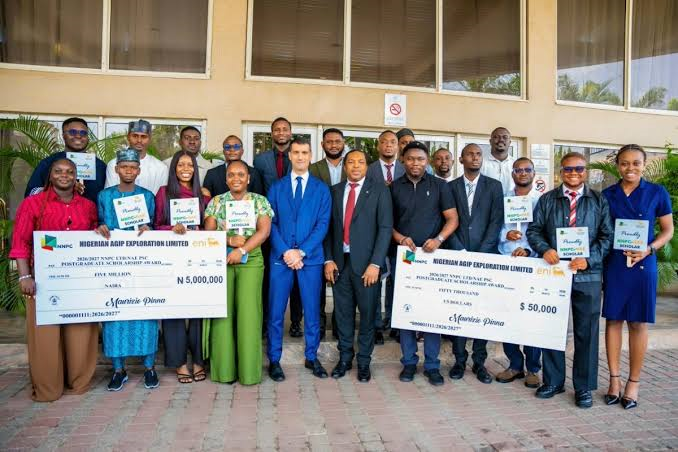
NNPC, Eni Award Postgraduate Scholarships to 30 Nigerian Graduates
The NNPC/Eni Joint Venture has awarded postgraduate scholarships to 30 Nigerian graduates for the 2026/2027 academic session, selecting the beneficiaries from over 3,000 applicants. Ten scholars will study at top universities abroad, including Imperial College London and the University of Aberdeen, while the remaining 20 will pursue degrees in Nigerian institutions across engineering, geosciences, renewable energy, and energy transition disciplines.
 Youth Empowerment
100,000 Pupils Get N20,000 Each Under N2bn Fund
First Lady Oluremi Tinubu has launched a N2 billion Learners Retention Support Programme that will provide N20,000 each to 100,000 pupils in its first phase, alongside the distribution of two million packs of sanitary towels and back-to-school materials to girls in public basic schools across Nigeria. The initiative, flagged off to mark the 2026 International Day of the Girl Child, is designed to remove the financial and hygiene barriers that force thousands of Nigerian girls out of the classroo
Comments (0)
Leave a comment
All comments are moderated before publishing. Your email is never published.