
FG Unveils National EdTech Strategy to Reach 20 Million Out-of-School Children
The Federal Government has launched Nigeria’s first-ever National EdTech Strategy, a sweeping policy framework designed to wire classrooms, train teachers, standardise digital content, and close the country’s gaping education divide. But with 20 million children out of school, erratic power supply, and a yawning digital skills gap, analysts warn the strategy will live or die on implementation—and funding.
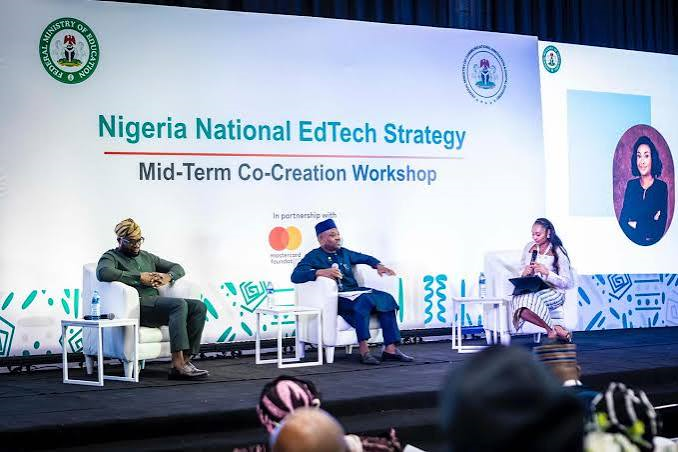
Federal Government has unveiled Nigeria’s first National EdTech Strategy, a landmark policy framework aimed at transforming the country’s education sector through technology, digital infrastructure, teacher training, and standardised content delivery, in what officials are describing as the most ambitious attempt yet to drag Africa’s most populous nation into the digital learning era.
The strategy, developed through consultations with the Ministry of Education, education technology stakeholders, development partners, and private-sector players, sets out a national roadmap for integrating technology into teaching, learning, assessment, and education administration at every level—from primary schools in rural communities to universities in major cities. It arrives at a moment of acute crisis: Nigeria accounts for one of the highest numbers of out-of-school children in the world, learning poverty remains stubbornly high, and the quality of instruction in public schools continues to lag behind national aspirations.
For years, edtech in Nigeria has been a fragmented, largely private-sector affair—driven by startups offering online tutoring, learning management systems, and mobile applications to fee-paying urban families. The new national strategy attempts to change that by establishing common standards, creating a framework for public-private partnerships, and positioning government as a coordinator rather than a bystander. Officials argue that without a national strategy, edtech interventions remain scattered, duplicative, and inaccessible to the students who need them most.
The framework is expected to address several foundational challenges. First, digital infrastructure: the strategy recognises that connectivity and power remain the biggest barriers to technology-enabled learning in Nigeria, and proposes partnerships to expand internet access and solar-powered solutions for schools in underserved areas. Second, teacher capacity: a strategy without trained teachers is a dead letter, and the plan reportedly includes provisions for digital literacy training and continuous professional development for educators. Third, content: the strategy seeks to standardise digital learning materials, align them with the national curriculum, and ensure quality control in a market flooded with unregulated edtech products.
The strategy also touches on data and governance—building systems to track student performance, improve education planning, and hold institutions accountable. For a sector where data is often scarce, outdated, or unreliable, this component could prove transformative if implemented properly.
Stakeholders have welcomed the initiative but warned that Nigeria’s history with education policy is littered with well-intentioned documents that never left the shelf. The Universal Basic Education programme, various curriculum reforms, and successive teacher-training initiatives have all struggled with implementation, funding gaps, and political discontinuity. The EdTech strategy faces the same risks—amplified by the cost of devices, the fragility of the power grid, and the digital divide between urban and rural communities.
Analysts also point to the danger of treating technology as a silver bullet. Access to devices does not automatically improve learning outcomes; without pedagogy, teacher support, and content relevance, edtech can become an expensive distraction. The strategy’s success will depend on whether it prioritises learning outcomes over gadget procurement, and whether state governments—which control most basic education—buy into and fund the framework.
The private sector’s role will be critical. Nigeria’s edtech ecosystem has produced innovative solutions—mobile learning platforms, offline content delivery, teacher-training apps—but most operate at small scale, constrained by funding, regulation, and market fragmentation. A national strategy could provide the coordination and credibility needed to scale proven solutions, while guarding against the risk of corporate capture.
For Nigerian children, the stakes are difficult to overstate. A child in a rural community with no qualified teacher, no textbooks, and no electricity is unlikely to benefit from any strategy unless the implementation reaches her classroom, her teacher, and her community. The EdTech strategy offers a framework; delivery remains the hard part.
The Federal Government has signalled that the strategy will be accompanied by implementation plans and partnerships, but details on funding, timelines, and accountability mechanisms remain thin. Education stakeholders will be watching closely to see whether this becomes a genuine turning point or another glossy document in a long line of unimplemented reforms.
What is clear is that Nigeria cannot educate its way out of poverty and unemployment using the methods of the past. The National EdTech Strategy is a bet that technology—properly deployed, funded, and governed—can help close the gap. Whether that bet pays off will depend less on the elegance of the strategy than on the political will to execute it.
Sponsored

Related stories
 Tech & Education
UNILAG Jumps Over 700 spots in 2027 World Rankings,Making Africa's Biggest Gain
The University of Lagos has recorded Africa’s biggest ranking leap, soaring from the 1,401–1,500 band to joint 697th in the 2027 QS World University Rankings: Sustainability. The milestone—driven by gains in environmental education, governance and equality—marks Nigeria’s strongest global showing yet and lifts the country to fourth in Africa, but experts warn that six universities out of more than 300 is a wake-up call, not a victory lap.
 Tech & Education
Taraba Governor Approves Lecturers’ Allowances, Urges ASUU to End Strike
Governor Agbu Kefas has approved 100 per cent payment of CATA, CONTTA and Earned Academic Allowances, including arrears dating back to January 2026, in a bid to break a month-long strike that has paralysed Taraba’s tertiary institutions and left final-year students in limbo. But ASUU has yet to formally call off the action—and the ball is now in the union’s court.
 Tech & Education
Nile University Replaces Certificate Culture with AI, Robotics and Skills Training
Nile University of Nigeria is betting big on artificial intelligence, robotics, and hands-on technical training to close the gap between what graduates learn in classrooms and what employers actually need. With 100 AI-powered interactive boards, a planned robotics laboratory, and a new vocational institute, Vice-Chancellor Dilli Dogo says the era of certificates without competence is over.
 Tech & Education
Tantita, Honerich Empower Sapele Pupils with Back-to-School Relief
Tantita Security Services Nigeria Limited and Honerich Nigeria Limited have extended their back-to-school CSR drive to Ogwere Primary School, Ikwegwu, and Ethiope Modern Primary School in Sapele, Delta State, distributing school bags, exercise books, water bottles, and mathematical sets to pupils in underserved communities—reinforcing a growing corporate push to keep host-community children in school and learning.
Comments (0)
Leave a comment
All comments are moderated before publishing. Your email is never published.