
South Korea to Disable Public Wi-Fi Around Exam Centres to Prevent AI Cheating
South Korea will suspend public Wi-Fi services around university entrance examination centres for 24 hours to prevent technology-assisted cheating.
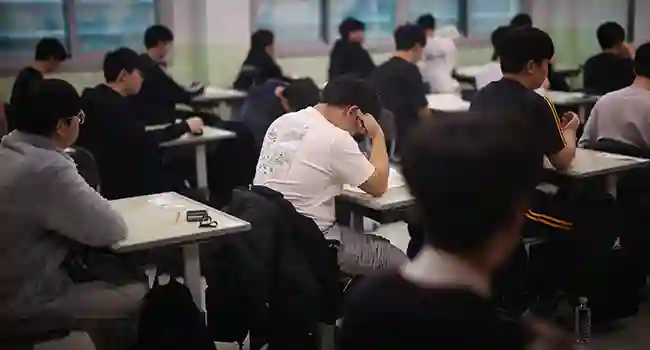
South Korea has announced plans to temporarily disable public Wi-Fi services around university entrance examination centres as part of measures to prevent cheating during its highly competitive national university entrance examination.
The restriction began at 6 p.m. on Wednesday, November 18, and is scheduled to remain in effect until 6 p.m. on Thursday, November 19, covering a 24-hour period around the 2027 College Scholastic Ability Test, commonly known as Suneung.
According to South Korea’s Yonhap News Agency, the measure will affect public Wi-Fi networks within a 100-metre radius of examination centres nationwide.
The country’s three major telecommunications operators, SK Telecom, KT and LG Uplus, are cooperating with the government to suspend their Wi-Fi services in the designated areas.
The restrictions also cover networks installed in schools and public spaces around examination venues, including services operated by government agencies, local authorities and education offices.
Authorities said the measure was introduced to prevent candidates from using sophisticated electronic devices, including smart glasses and miniature cameras, to transmit examination questions to external devices and receive answers through artificial intelligence systems.
Depending on the equipment, operators will suspend network broadcasts, disconnect internet connections or switch off certain Wi-Fi devices.
However, authorities acknowledged that the measure cannot completely prevent wireless communication because privately installed routers and mobile phone hotspots cannot easily be disabled across all locations.
The government is also strengthening surveillance around examination centres to discourage candidates from using unauthorised electronic devices.
The Suneung examination is one of South Korea’s most important academic assessments, determining admission opportunities into universities and influencing students’ future educational and career prospects.
The nationwide Wi-Fi restriction reflects growing concerns about the use of artificial intelligence and advanced electronic devices to facilitate examination malpractice.
South Korean authorities have therefore introduced additional security measures to protect the integrity of the examination and ensure that candidates compete under fair conditions.
Sponsored

Related stories
 News
Dangote Refinery to Increase IPO by 30% to $2.1bn After Strong Demand
Dangote Refinery plans to expand its public offering by 30 per cent after investor demand reached nearly three times the shares initially offered.
 News
Sowore Urges FG to Legalise Cannabis, Says Nigeria Could Generate N2.86trn Annually
Omoyele Sowore wants Nigeria to regulate cannabis production and sales, arguing that legalisation could generate revenue, create jobs and support manufacturing.
 News
Tony Elumelu to Lead Private-Sector Mobilisation at West Africa Investment Summit
Nigerian investor Tony Elumelu will lead private-sector mobilisation at a regional summit seeking to attract investment and accelerate economic integration.
 News
AU: Africa Loses $80bn Annually to Illicit Financial Flows
The African Union says illicit financial flows and corruption drain billions of dollars from Africa annually, undermining development and public services.
Comments (0)
Leave a comment
All comments are moderated before publishing. Your email is never published.