
South African Golfer, Kenyan Chef Arrested With 50kg Cannabis in Lagos
The National Drug Law Enforcement Agency has arrested a 37-year-old South African professional golfer and a 25-year-old Kenyan chef over an alleged attempt to smuggle 50.40kg of cannabis into Nigeria through the Murtala Muhammed International Airport, Lagos.
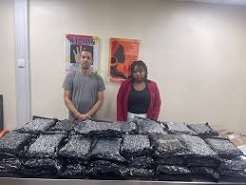
The National Drug Law Enforcement Agency (NDLEA) has arrested a South African professional golfer, Grobler Henlo, and a Kenyan chef, Abubakar Faiza Njambi, over their alleged involvement in an international drug trafficking operation involving 50.40kg of a potent cannabis strain known as Loud.
The suspects, aged 37 and 25 respectively, were arrested at the Murtala Muhammed International Airport (MMIA), Ikeja, Lagos, following investigations into an alleged attempt to smuggle the illicit substance into the country.
According to the agency, Henlo arrived in Lagos from South Africa aboard a South African Airways flight on October 11, 2026, and was intercepted at the Terminal 2 arrival hall.
A search of two travelling boxes in his possession reportedly led to the discovery of 46 parcels of Loud weighing 50.40kg.
Investigations revealed that the boxes carried Njambi's luggage tags, while she had collected two other boxes bearing Henlo's tags from the airport conveyor belt before leaving the facility.
The agency said the exchange of luggage tags was a deliberate strategy by the trafficking syndicate to conceal ownership of the consignments and make it difficult to identify the individuals responsible if the drugs were intercepted.
During preliminary questioning, Henlo reportedly told investigators that he was recruited by a South African associate identified as Shanel, who connected him with other members of the syndicate he had never met physically.
He said a driver picked him up from his residence in South Africa, handed him four travelling boxes and took him to the airport, where he was instructed to meet Njambi and exchange luggage tags.
The golfer, who travelled in business class while his alleged accomplice flew economy, reportedly said he was promised 5,000 South African rand upon successful delivery of the consignment.
Further investigations showed that tracking devices had been installed in the travelling boxes and on Henlo's mobile phone, enabling members of the syndicate to monitor the couriers and their consignments.
The NDLEA said Njambi's passport details, recovered from Henlo's phone, were used to place her on its watchlist, leading to her arrest on October 15 at the airport's departure boarding gate as she attempted to return to Kenya.
The 25-year-old private chef reportedly told investigators that she was recruited through an arrangement involving a friend in Kenya, who persuaded her to accept an offer of $8,000 for successfully delivering the consignment.
She said she travelled from Kenya to South Africa on October 4, stayed in a hotel for about a week and met Henlo at the airport on October 11, where they exchanged luggage tags before travelling to Lagos.
Upon arrival, she reportedly collected the two boxes bearing Henlo's tags before being transported by a driver to a hotel in the Lekki area.
The NDLEA said the claim tag for the two boxes bearing her name, which she abandoned at the airport, was recovered from her hand luggage. Both suspects subsequently identified each other during an identification parade.
Commenting on the arrests, NDLEA Chairman, Brig.-Gen. Mohamed Buba Marwa (retd.), said the case demonstrated how international drug trafficking organisations were recruiting professionals as couriers in the belief that their backgrounds could help them avoid scrutiny.
He warned that no profession, passport or travel class would provide protection for individuals involved in drug trafficking through Nigeria's entry points.
Marwa urged officers at airports and other border facilities to remain vigilant and professional, while sustaining efforts to reduce both drug supply and demand through enforcement and public awareness campaigns.
Sponsored

Related stories
 News
‘I Was Shaving in Aso Rock When Water Ran Out, We Must Fix These Problems’ — Tinubu
President Bola Tinubu says water supply failed at the Presidential Villa while he was shaving, pledging to address Nigeria’s electricity and infrastructure challenges.
 News
I Feared Losing My Leg After Shooting — Broda Shaggi
Nigerian comedian Broda Shaggi says he feared losing his leg after a stray bullet injury left him unable to walk for months.
 News
My Son Faced Rejection Over Marriage Controversy — Pete Edochie
Veteran actor Pete Edochie says his son, Yul, faced public and professional rejection after his controversial decision to marry actress Judy Austin.
 News
Emirs Found Guilty of Immoral Conduct Should Be Removed Immediately — Gumi
Islamic cleric Ahmad Gumi says traditional rulers found guilty of immoral conduct should be dethroned, following allegations against the Emir of Daura.
Comments (0)
Leave a comment
All comments are moderated before publishing. Your email is never published.