
Nigeria, US Sign Pact to Deepen Mining Investment
Nigeria and the United States have signed a framework agreement to deepen mining investment and develop mineral resources.
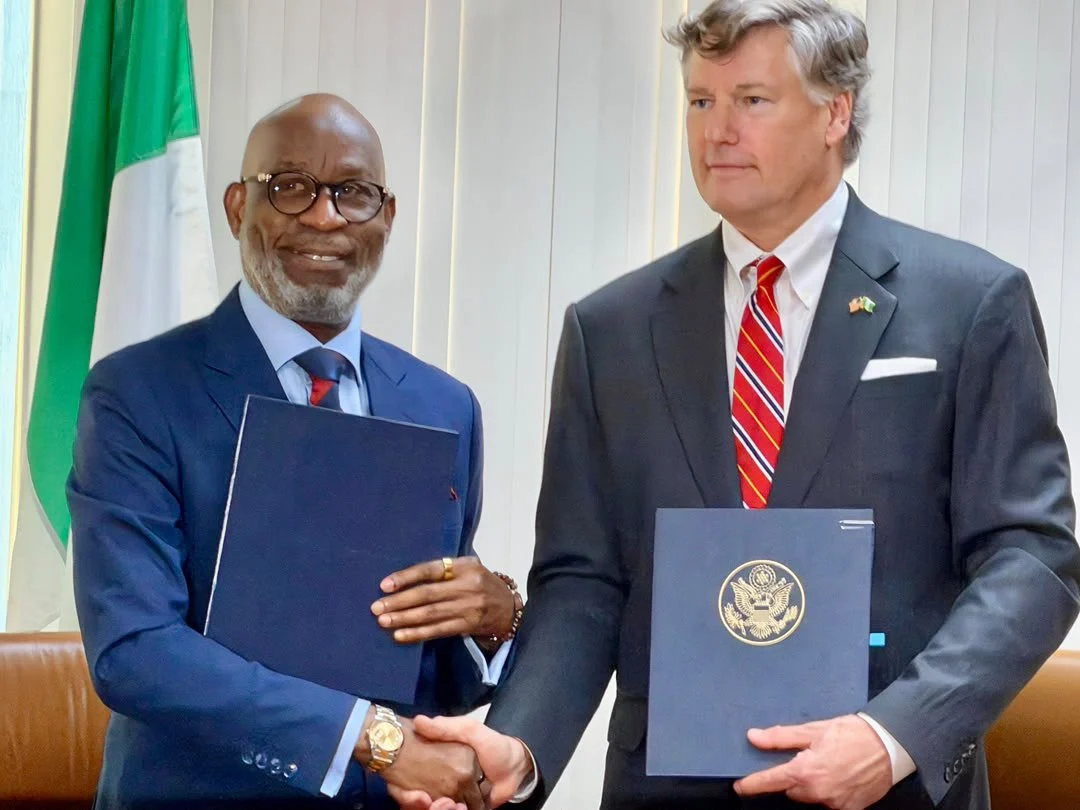
Nigeria and the United States have signed a framework agreement aimed at deepening American investment in Nigeria’s mining sector and developing the country’s mineral resources.
The agreement was signed in New York by Nigeria’s Minister of Solid Minerals Development, Dele Alake, and US Deputy Secretary of State Christopher Landau on the sidelines of the 81st United Nations General Assembly.
The framework is designed to strengthen cooperation across Nigeria’s mineral value chain, covering geological data and exploration, mineral development and processing, infrastructure, and technical capacity building.
Nigeria estimates the value of its mineral resources at about $700 billion, with the government seeking to attract greater investment into the sector as part of efforts to diversify the economy beyond oil.
Alake said the agreement would provide a platform for government-to-government cooperation while supporting business-to-business transactions and commercial partnerships.
He said Nigeria’s objective was to move beyond exporting raw minerals and retain more value within the country through increased local processing, skills development, quality jobs and opportunities for Nigerian businesses.
The minister said the next phase would focus on identifying viable projects, mobilising investment and developing partnerships capable of producing measurable economic benefits.
The agreement also places emphasis on secure and resilient supply chains for critical minerals, as demand grows globally for minerals used in technologies such as electric vehicle batteries and renewable energy infrastructure.
Landau said the United States viewed Nigeria as an important regional partner and expressed Washington’s willingness to support the country’s economic growth.
The agreement comes as Nigeria continues efforts to develop its largely underdeveloped mining industry and attract international capital and technology into mineral exploration and processing.
The country has deposits of several commercially important minerals, including lithium, gold, tin, gemstones, iron ore and phosphate.
Government officials have increasingly promoted local processing as a way of creating jobs and increasing the economic value derived from Nigeria’s mineral resources.
The implementation of the framework will now determine how quickly the partnership translates into specific mining projects, processing facilities, infrastructure investments and commercial opportunities.
The pact represents a new framework for Nigeria-US cooperation in the mining sector, with both countries expected to work towards identifying projects and investments that can strengthen the mineral value chain and expand economic opportunities.
Sponsored

Related stories
 News
News
EU Backs FG’s Broadband Expansion with €14m Grant
The European Union and EBRD are supporting Nigeria’s planned 90,000-kilometre fibre-optic network to expand affordable broadband access nationwide.
 News
News
Tinubu Seeks Senate Nod to Replace ASCON With National School of Government
President Bola Tinubu has asked the Senate to approve a bill seeking to repeal the law establishing the Administrative Staff College of Nigeria and replace it with a National School of Government focused on leadership development and public-sector capacity building.
 News
News
Adeleke Dances With Tinubu at APC Campaign Council Inauguration
Osun State Governor Ademola Adeleke joined President Bola Tinubu at the inauguration of the APC’s 2027 Presidential Campaign Council in Abuja, drawing attention to their political collaboration ahead of the general election.
 News
News
Tinubu Seeks Repeal of Indian Hemp Act in Drug Law Overhaul
President Bola Tinubu has asked the Senate to repeal the Indian Hemp Act as part of a proposed overhaul of Nigeria’s drug enforcement laws, aimed at consolidating the legal framework for combating illicit drugs.
Comments (0)
Leave a comment
All comments are moderated before publishing. Your email is never published.