
Nigeria’s Cassava Industry Faces Crisis as Imports Surge 13,293% in Five Years
Nigeria’s cassava processing industry is facing mounting pressure as starch imports increased by 13,293 per cent between 2020 and 2025, leaving local factories operating below capacity, farmers struggling with falling prices and processors burdened by debt.
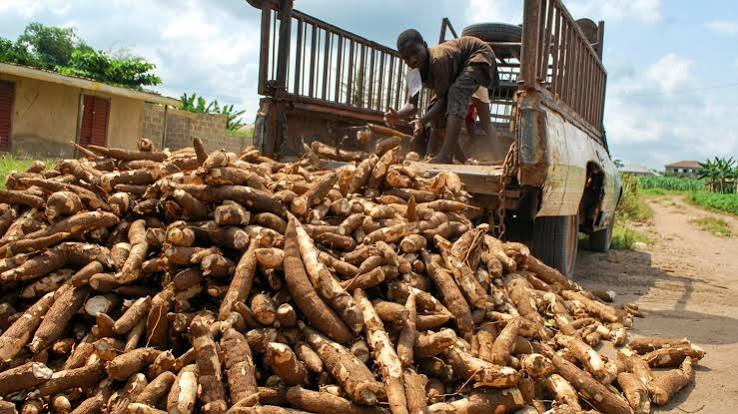
Nigeria’s cassava industry is facing a deepening crisis as imports of cassava starch surged by 13,293 per cent in five years, undermining local processing businesses despite the country’s position as the world’s largest cassava producer.
Data from the World Bank’s World Integrated Trade Solution, based on United Nations Comtrade records, showed that Nigeria’s cassava starch imports rose from 24.1 tonnes in 2020 to 3,227.7 tonnes in 2025.
The increase has intensified pressure on domestic processors, many of which are struggling to compete with cheaper imported alternatives, while farmers face declining demand, falling farm-gate prices and mounting production costs.
The President of the Large-Scale Starch and Derivatives Producers Association of Nigeria, Oluyemisi Iranloye, said the situation had severely affected farmers and industrial processors.
Iranloye, who is also the Vice-President of the Industrial Cassava Stakeholders Association of Nigeria and Chief Executive Officer of Psaltry International, disclosed that farmers could spend about ₦800,000 cultivating a hectare of cassava but earn only approximately ₦300,000 from selling their produce at prevailing farm-gate prices.
She said several processing companies had reduced operations because of weak demand, leaving factories running at about 15 per cent of their installed capacity.
According to her, facilities that should generate approximately ₦10 billion annually were barely generating ₦1 billion, with some businesses struggling to repay loans.
She warned that reduced purchases by industrial processors had left smallholder farmers with fewer buyers, worsening the glut of cassava and depressing prices.
Iranloye attributed the growing preference for imported starch partly to changes in the tariff structure, which she said had made competing products from abroad cheaper than locally manufactured alternatives.
She explained that tariffs on imported corn starch and pharmaceutical-grade starch had been reduced from about 15 per cent to five per cent, weakening the competitiveness of Nigerian processors.
She also alleged that some pharmaceutical companies imported more starch than they required under zero-duty arrangements and sold the excess in the domestic market, further increasing competition for local manufacturers.
Food security expert and farmer, Africanfarmer Mogaji, warned that the situation could worsen as some multinational manufacturers had secured imported supplies extending into 2027 and the first quarter of 2028.
He said local processors and farmers had accumulated significant debts after investing in production capacity during periods of stronger domestic demand.
Mogaji attributed the competitiveness of imported products, particularly those from Thailand, to investments in infrastructure, logistics and agricultural production.
He called for consistent agricultural policies that would allow farmers and processors to plan investments over longer periods, rather than depending on changing government interventions.
Similarly, Managing Director of Niji Group, Kolawole Adeniji, said rising production costs, insecurity, expensive machinery, diesel and transportation had forced farmers to reduce the size of their cultivated land.
Adeniji, who has more than 36 years of experience in agriculture and operates a cassava farm covering over 4,000 acres, warned that reduced farming activities in 2026 could further increase import dependence.
He also identified inadequate financing as a major obstacle, arguing that agricultural loans should provide repayment periods of about three years to accommodate the production cycle.
Despite the challenges, Nigeria has developed considerable cassava processing capacity.
Industry records from June 2026 listed 62 processor entries affiliated with the Large-Scale Starch and Derivatives Producers Association, including companies involved in starch, high-quality cassava flour and ethanol production.
Fifty-five entries were engaged in starch and high-quality cassava flour processing, with a combined listed daily capacity of 1,662.5 tonnes. Seven ethanol-related processors had a combined recorded capacity of 1.073 million litres daily.
However, the association acknowledged that some facilities were not operating at full capacity because of prevailing industry challenges.
Nigeria produced more than 63 million tonnes of cassava in 2024, accounting for approximately 18 per cent of global output, according to data from the Food and Agriculture Organisation.
Nevertheless, only about five per cent of the country's cassava production goes into industrial processing, while the majority is consumed locally as food.
President of the Industrial Cassava Stakeholders Association of Nigeria, Segun Ladele, said about 80 per cent of production was consumed domestically, while approximately 15 per cent went into exports.
Industry stakeholders have called for investments in mechanisation, improved planting materials, affordable financing, transportation, processing infrastructure and more consistent policies to strengthen local production.
They warned that without addressing the cost disadvantages confronting domestic processors, Nigeria could continue importing processed cassava products despite its enormous production capacity.
Sponsored

Related stories
 News
Only 14 Nigerian States Pay Pensions Regularly — PenCom Discloses
PenCom says only 14 of Nigeria’s 36 states meet regular pension payment obligations, raising concerns over retirees’ welfare and outstanding benefits.
 News
Nigeria’s Inflation Rate Drops to 14.06% in October — NBS
Nigeria’s headline inflation eased to 14.06 per cent in October from 14.63 per cent in September, as food inflation also declined.
 News
UniAbuja Land Reduction Approved by Wike’s Predecessor — FCTA
FCTA says former minister Mohammed Bello approved the recommendation to reduce UniAbuja’s land, insisting Wike implemented an earlier decision.
 News
Two Killed, 30 Inmates Escape in Chad Prison Break
Two people have been killed and three seriously injured after 30 inmates escaped from a prison in Mongo, central Chad, amid widespread destruction.
Comments (0)
Leave a comment
All comments are moderated before publishing. Your email is never published.