
Low Voter Turnout, BVAS Glitches Mar INEC Nationwide Mock Election
INEC’s nationwide mock presidential election recorded poor voter participation in several states, alongside technical glitches, logistical delays and slow result uploads, despite stronger turnout in some locations.
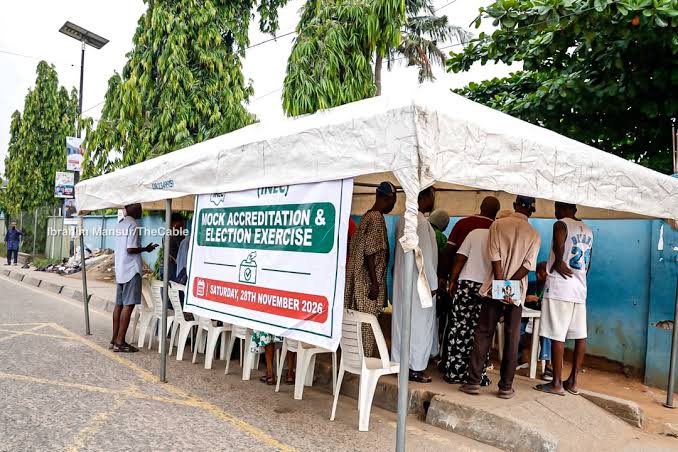
The nationwide mock accreditation and voting exercise conducted by the Independent National Electoral Commission (INEC) ahead of the 2027 general elections has recorded low voter turnout in several states, with technical challenges and inadequate public awareness affecting participation.
The exercise, held on Saturday across 17,676 selected polling units in the 36 states and the Federal Capital Territory, was designed to assess the functionality of the Bimodal Voter Accreditation System (BVAS) and electronic transmission of results through the INEC Result Viewing Portal (IReV).
While Plateau, Nasarawa, Akwa Ibom and Edo states recorded encouraging participation, several polling units in Benue, Abia, Adamawa, Kaduna, Bauchi, Borno, Kebbi, Katsina, Sokoto, Zamfara, Oyo, Ogun, Ondo, Bayelsa and Kano experienced poor turnout, with some recording no voters.
The exercise, which commenced at 8:30 a.m. and ended at 2:30 p.m., also exposed challenges involving malfunctioning accreditation devices, delayed arrival of election materials and difficulties retrieving voters’ registration details.
A major concern was the slow uploading of results to the IReV portal. By 9:10 p.m., 14,726 of the expected 17,614 results, representing 83.32 per cent, had been uploaded.
INEC Chairman, Prof. Joash Amupitan, however, expressed satisfaction with the exercise in Plateau State, where he monitored the process alongside the state Resident Electoral Commissioner, Prof. Samuel Egwu.
Amupitan described the turnout and performance of the electoral technology in the state as impressive, noting that voters were accredited within seconds and the process remained orderly.
He said the commission was committed to conducting free, fair, inclusive, credible and transparent elections in 2027.
The INEC chairman also disclosed that the commission was deploying its Election Risk Management (ERM) framework to identify vulnerable polling units and potential security flashpoints ahead of the elections.
According to him, information gathered through the assessment had been shared with relevant law enforcement agencies to facilitate preventive measures.
He added that INEC had strengthened its collaboration with security agencies, including the military, police and Nigeria Security and Civil Defence Corps, to protect voters, electoral officials, election materials and National Youth Service Corps members before, during and after the polls.
In Lagos State, the Resident Electoral Commissioner, Prof. Ayobami Salami, reported satisfactory BVAS performance at the polling units he visited, saying accreditation took less than one minute per voter.
He disclosed that INEC had procured approximately 57,000 additional BVAS devices to strengthen its existing capacity and reduced the maximum number of voters assigned to each machine from 1,250 to 850 to prevent overcrowding and delays.
However, participation remained low in some parts of the state, including Ijegun, Satellite Town and Festac in the Amuwo-Odofin area. Tension was also reported in Yaba, where some voters confronted electoral officials over alleged changes to their polling units without prior notification.
The disagreement did not escalate into violence.
In Benue State, some polling units recorded extremely low participation despite having hundreds of registered voters. At LGEA Primary School, Wurukum, only six of 833 registered voters participated, while no voter had turned up at High Level Market polling unit as of 1:30 p.m.
Similar situations were reported in parts of Kaduna, where no voter was seen at the polling unit of former Governor Nasir el-Rufai during the visit, while only one person was observed voting at Governor Uba Sani’s polling unit.
Other states, including Bauchi, Borno, Kebbi, Katsina, Sokoto and Zamfara, also recorded poor participation, with some voters encountering difficulties during BVAS accreditation.
In Ondo State, some elderly voters complained that the machines initially failed to recognise their faces, although the devices later became functional.
The state Resident Electoral Commissioner, Dr Mutiu Agboke, attributed the low turnout to inadequate public awareness, environmental factors and expectations of financial inducements among some residents.
Abia State also experienced poor participation, with several polling units in Umuahia recording minimal or zero turnout. Some residents blamed inadequate publicity and the restriction of the exercise to selected polling units.
In Nasarawa State, however, participation was encouraging despite delays in the arrival of electoral officials and sensitive materials in some remote communities.
The commission said the mock exercise would help identify operational and technological shortcomings requiring attention before the 2027 general elections.
Amupitan reiterated that the presidential and National Assembly elections would hold on January 16, 2027, while governorship and State Houses of Assembly elections were scheduled for February 6, 2027.
Sponsored

Related stories
 News
Delta: ‘You Can’t Murder Our President-General and Expect Us to Keep Quiet’ — Oborevwori Warns
Delta Governor Sheriff Oborevwori condemns the killing of Uduere’s President-General, warning against community attacks and the use of firearms during political campaigns.
 News
‘No Anointing Is Above Government’ — Daddy Freeze Blasts Jimmy Odukoya Over Bench Warrant
Daddy Freeze criticises Jimmy Odukoya over his handling of the church leadership crisis, urging him to respect court proceedings and protect his father’s legacy.
 News
INEC Disowns NEIS.NG, Threatens Action Over ‘False and Misleading’ Mock Election Results
INEC disowns NEIS.NG, says mock exercise featured no real candidates, and warns it may act against those spreading misleading results.
 News
JAMB to Delete Unaccepted 2021-2025 Admission Offers by Monday
JAMB gives candidates with outstanding 2021–2025 admission offers until Monday to accept or reject them, warning that pending offers will revert to Not Admitted.
Comments (0)
Leave a comment
All comments are moderated before publishing. Your email is never published.