

United States astronauts have safely returned to Earth after completing a 10-day mission in space, marking a key milestone in preparations for future lunar exploration.
The crew, deployed by NASA, spent the duration of the mission in microgravity, travelling around the Moon aboard the Orion spacecraft before making a successful splashdown.
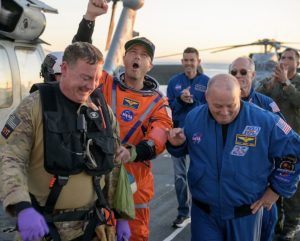
Following their return, the astronauts are expected to undergo a series of medical checks to assess how their bodies readjust to Earth’s gravity. They will also complete an “obstacle course” test designed to evaluate balance, coordination, and overall physical recovery after their time in space.
The team is scheduled to arrive at Ellington Field in Houston later on Saturday, where they will reunite with their families. Officials indicated that arrival activities would take place within a flexible window, subject to final flight conditions.
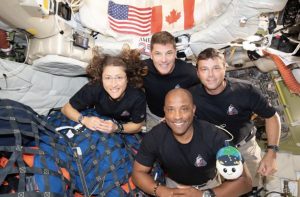
Mission managers praised the performance of the spacecraft and crew, describing the flight as a major step forward in the agency’s long-term lunar ambitions. The mission carried Reid Wiseman, Victor Glover, Christina Koch, and Jeremy Hansen, who orbited the Moon in what officials called a critical test of deep space travel systems.
Despite the success, NASA acknowledged that the mission revealed several technical issues requiring further review. Engineers are expected to closely inspect the spacecraft’s heat shield, address a valve concern in the service module, and resolve a malfunction involving the onboard toilet system.

Speaking after the splashdown, Amit Kshatriya said the agency is working within a tight timeline as it prepares for the next phase of its Artemis programme. He noted that lessons from the mission would be critical to ensuring readiness for Artemis III, which is expected to return humans to the Moon.
The mission underscores growing momentum in global space exploration, with outcomes expected to shape future crewed missions beyond Earth orbit.


